


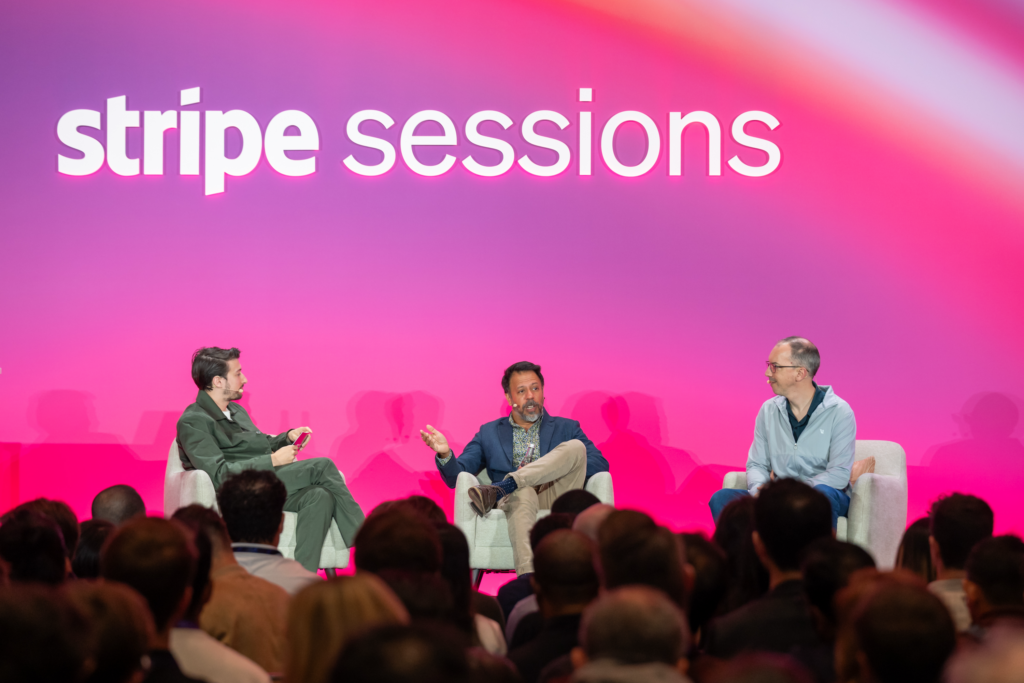
At Stripe Sessions 2026, I joined Guillaume Poncin of Alchemy and Steve Kaliski of Stripe for a session called “The Agentic Commerce Commons.” Nearly 1,000 people came. I was literally mobbed after the panel and got loads of follow up questions on AAIF and, more broadly, agentic commerce. In fact, they should have just called it the Agentic Commerce Conference. It truly was a dominant theme, on everyone’s mind – from attendees to vendors on the expo floor.
The crowd was a wide variety of folks from nearly every walk of the agentic landscape – payments people, infrastructure teams, crypto natives, identity vendors and platform builders all trying to work out which part of the elephant they were holding. The people I spoke with – vendors, speakers, and attendees – all struck the same chord. Agentic commerce is coming. How do we make sense of the alphabet soup of protocols, standards, pieces, bits and flotsam that is agentic commerce, and how can make a future that is more cohesive and standardized?
Here are five lessons I took away.
1. Agentic Commerce Is A Pressing Implementation Problem
The conversation has moved on from whether agents will transact. They will. The harder question is how to make those transactions safe, comprehensible, reversible, auditable and not a spectacular fraud vector running at scale and machine speed.
Most people I spoke with were not looking for a grand theory. They were trying to work out where to start. Payments, identity, checkout, fraud, verification, authorisation, refunds and human approval all appear simple when drawn as boxes on a slide. They become less simple when an agent is actually trying to buy something, commit money, or act on behalf of a person or business.
2. Commerce Is Becoming A Chain Of Delegated Authority
A human may ask an agent to buy something, renew something, compare something or negotiate something. That agent may then call tools, merchants, identity systems, payment systems, risk systems and other agents. At each step, someone needs to know who is acting, on whose behalf, with what permission, under what limits, and with what recourse if the result is wrong.
That is not merely a payments problem. It is the oldest problem in commerce, dressed in new clothes: trust between parties that do not fully know each other. The novelty is that the parties now include software acting with partial autonomy, sometimes at several removes from the human who started the chain.
3. Protocols Are The Hard Part, Not The Decorative Part
Authentication, checkout, machine payment and human approval do not sit tidily in separate boxes. They overlap in the path from human to agent, from agent to agent, and from agent to merchant.
The present landscape reflects that complexity. AP2, UCP, MPP, x402 and other efforts are being explored against different parts of the system, from product discovery and checkout to payment, settlement, verification, and agent-to-agent coordination. It is too early, and not especially useful, to crown winners. The more important question is whether the eventual points of convergence are transparent, interoperable and governed in the open, or whether they harden into private interfaces that everyone else must adapt to.
4. Physical Commerce Is The Stress Test
Agent-to-agent payment for a digital service is one thing. Buying a physical good is another. Physical commerce drags the rest of the world into the protocol: inventory, shipping, substitutions, returns, fraud checks, merchant policy, chargebacks, liability and the moment when the human must be brought back into the loop.
A system that can pay autonomously may still fail at commerce if it cannot handle the mundane indignities of the real world. Parcels are less forgiving than APIs.
5. The Commons Must Come Before The Kingdoms
This is why open, community-built and community-governed protocols matter. Not as a matter of ideological tidiness, but as a matter of market design. If the foundation of agentic commerce is owned by a handful of vendors, then the next generation of commerce will inherit the worst habits of the platform era before it has had a chance to mature.
There are useful precedents. The internet’s core protocols were not owned by one company. Linux moved critical computing infrastructure out of the competitive battlefield and into a governed commons. Competition did not vanish. It became more productive. The same argument runs through my recent writing on open infrastructure: openness preserves choice, governance prevents capture, and shared foundations make accountability possible.
Agentic commerce needs the same discipline. Companies should compete fiercely on products, risk models, developer experience, merchant reach, reliability and all the other things customers actually value. But the basic protocol layer for agents acting through other agents, with humans sometimes in the loop and sometimes several steps away, should not become another toll road.
The encouraging thing about Stripe Sessions was not that the industry has settled on an answer. It has not. The encouraging thing was that the people building this market increasingly understand the shape of the problem. The questions after the session were about implementation, governance, fraud, checkout, human approval, agent identity and interoperability. In other words, the right questions. By the next Sessions (or even sooner), I believe, we will have significant clarity on these questions and more.
Open infrastructure doesn’t build itself. If you’re working on agentic commerce, bring that work into the foundation. Join AAIF →