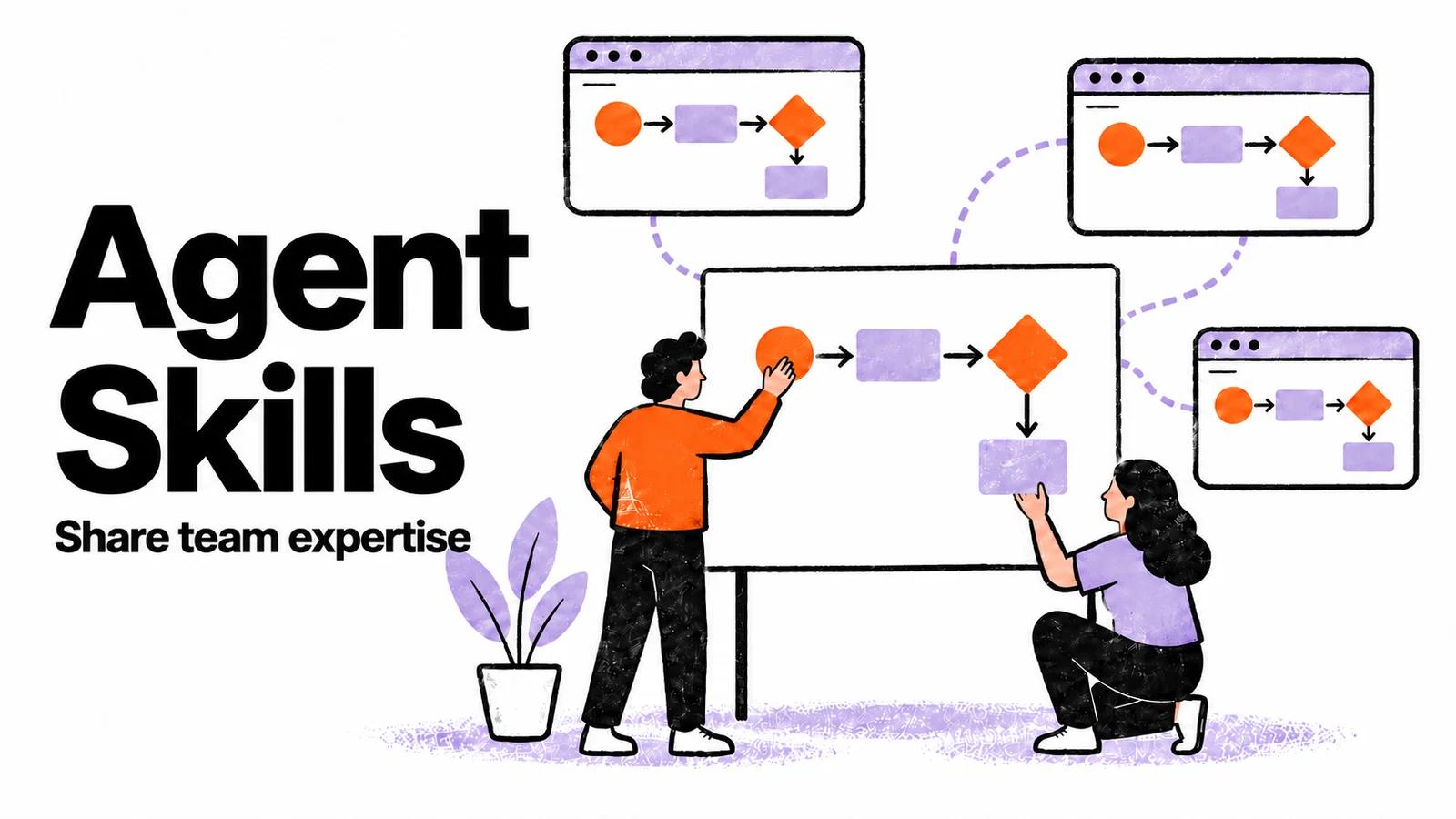

TLDR: Agent Skills is now a hosted project at the Agentic AI Foundation. Agent Skills lets people package their expertise into instructions that AI agents can use and colleagues can share. Its adoption across teams makes a neutral home for the standard a practical next step. The specification is open source under Apache 2.0 and CC BY 4.0, more than 70 agent platforms already support it, and over 1 million skills have been published with nearly 280 million installations.
Today, we're welcoming Agent Skills to the Agentic AI Foundation.
Agent Skills is an open standard for packaging reusable instructions and supporting resources that teach AI agents how to perform specific tasks. Originally developed by Anthropic, it gives people a way to share their knowledge across compatible agent tools. Bringing the project to AAIF will ensure neutral governance from a multi-company Technical Steering Committee that will guide its future.
An agent might know how to perform a task, but it doesn't automatically know your team's process or what a good result looks like. Those details come from the people doing the work. A skill gives them a place to explain the process, include examples, and define how to check the result.
For someone who repeats a task, that means they don't have to explain the same requirements every time. For a team, it means a colleague can use a workflow that someone else has already worked through and refined.
That’s the beauty of Agent Skills. The people who know the job can help define how an agent performs it, and their knowledge becomes something others can use.
Adoption is already substantial. In only seven months, a million skills have been listed on the popular skills.sh registry, and these skills have been installed nearly 280 million times. We’re seeing skills used across many types of knowledge work including software engineering, marketing, design, writing, and research.
Some of the knowledge captured in these skills is useful to anyone doing similar work. Some is specific to how a particular team operates.
When a colleague shares a useful skill, you get access to the thinking they've already put into the task. They've worked out which steps need attention and where the agent tends to get things wrong. You can start with that guidance and put your effort into the work in front of you.
That exchange gets more valuable as people use the skill. A colleague encounters an exception the author hadn't considered. Someone finds a clearer way to explain a requirement. Those improvements can become part of the shared skill, so the next person benefits from what the team has learned.
For that to happen, people need a way to find each other's skills and receive updates. A useful workflow saved on one person's laptop has a limited audience. Companies are responding by building internal skill libraries and marketplaces where employees can contribute their work and make it available to colleagues.
BetterFutureLabs describes that progression in its own team. Initially, engineers developed skills individually, then later created an internal marketplace to share them. Now, when a review catches a recurring issue that their code review skill missed, they update the skill and distribute the improvement. The lesson becomes available to everyone using it.
Making that contribution process accessible brings more people into it. At Brainlabs, employees across job functions submit skills through Notion, where they go through human review before being distributed back into their agents. Someone with a useful process to share can contribute without having to learn how to manage a software repository.
At Block, engineers share an internal marketplace of hundreds of skills covering workflows such as incident response, code review, and experiment setup. Engineers use those skills with their preferred agents, including Goose, Codex, Claude, and Amp, so teams can share their expertise without standardizing on a single agent.
I like what that says about whose knowledge gets to shape an agent's behavior. The person who understands the work has a direct way to explain how it should be done. Their colleagues can use that guidance, challenge it when it falls short, and help maintain it as the work changes.
Over time, a shared skill library represents a team's investment in its own knowledge. It contains decisions people have worked through and lessons they've learned together. That investment should remain useful when the team changes its tools.
A company might use different agents across departments or introduce a new one as its needs change. A common skill format gives it a way to carry its guidance across compatible tools. The agent still needs the right access and capabilities to perform the task, but the team has a shared starting point for teaching it how to work.
As more organizations depend on that format, its direction becomes a shared concern. People building agents need to understand how the standard will evolve. People creating skills need their experience to inform those decisions, including the limitations they encounter when sharing skills across tools.
That's why a neutral home is the right next step for Agent Skills.
The Agentic AI Foundation provides a place for that work, where organizations can collaborate on the open standard they depend on. Agent Skills will be guided by a Technical Steering Committee with core maintainers drawn from multiple organizations who serve as individuals and put the project and its users first.
The expertise in a skill comes from people. As we welcome Agent Skills into AAIF, we want those people involved in what comes next. Help shape the future of Agent Skills by contributing on GitHub or joining the community on Discord.
Share
Author

Angie Jones
View All PostsAngie Jones is the VP of the Agentic AI Foundation where she guides how agentic systems are designed, implemented, and adopted across the global developer ecosystem.
An award-winning educator and international keynote speaker, Angie shares her extensive knowledge with software companies and conference audiences worldwide.
As a Master Inventor, Angie is recognized for her innovative, out-of-the-box thinking, which has led to 27 patented inventions in virtual worlds, collaboration software, social networking, smarter planet initiatives, and software development processes.