

MCP gave agents a common way to call tools. A2A gave agents a common way to communicate. Neither automatically tells an agent which tool or agent exists, where to find it or whether it is the right one for the job. We have standardized the telephone call before finishing the telephone book.
Today, discovery is largely a human setup task. Someone knows that a GitHub MCP server exists, installs it, configures it and places it in front of the agent. That works when an agent has ten familiar tools. It becomes brittle when useful capabilities are distributed across organizations and appear or change while the agent is already working.
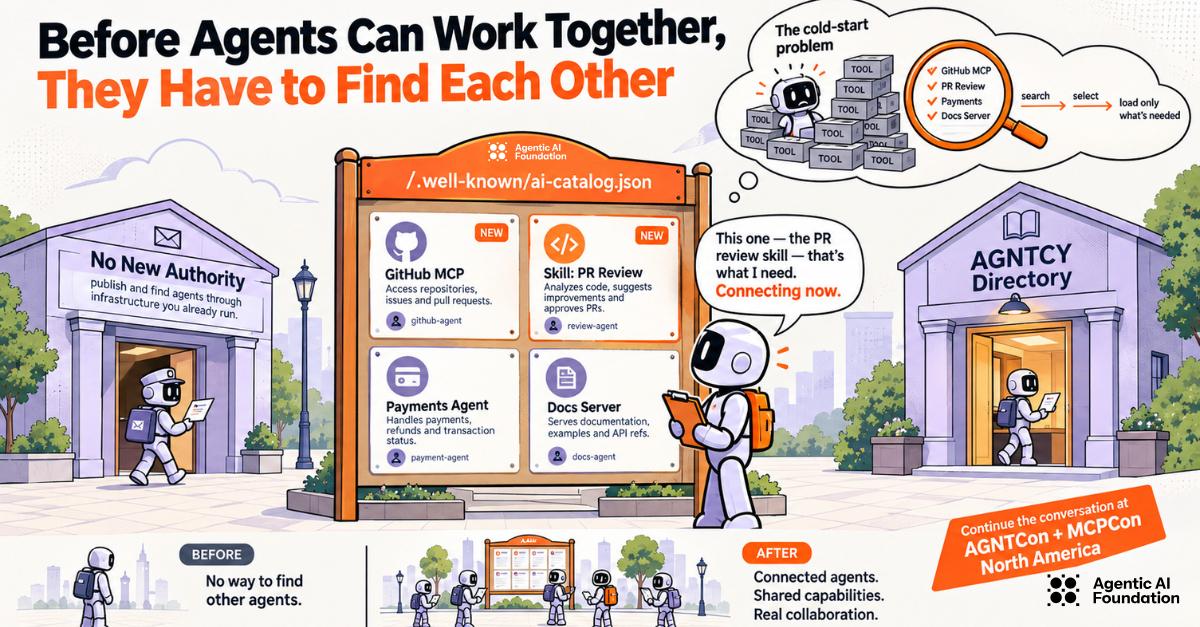
AI Catalog proposes a decentralized answer built around a predictable /.well-known/ai-catalog.json location. Organizations can publish MCP servers, Skills and related artifacts where agents can discover them during a task. A coding agent asked to review a pull request could find a relevant GitHub server, explain why it wants the capability and offer to connect it without requiring the user to know the integration existed beforehand.
The AGNTCY Directory and Agentic Resource Discovery efforts approach the same problem at agent scale: publish capabilities and identity so agents built with different frameworks can locate one another. DNS supplies an appealingly boring alternative for some cases. Infoblox’s “No New Authority” argues that organizations can publish and find agents using the distributed naming infrastructure they already operate rather than creating another central directory that must be trusted by everyone.
Discovery immediately creates a selection problem. IBM asks what happens when an agent has 100 tools and must pick one. Stuffing every schema into the context window is expensive and often makes selection worse. The client needs a way to search capabilities, expose only the most relevant tools and retrieve detail when it is needed. A2A’s agent cards add another layer by describing capabilities and supporting federated publication, while extensions and custom bindings allow the protocol to travel across different environments without losing its semantics.
The result is more than a registry. It is the beginning of a service-discovery layer for agentic systems: publish what a capability does, make it findable, carry enough identity to evaluate it and retrieve only the context required to use it. Agents will not become meaningfully interoperable merely because they speak compatible protocols. They also need a reliable way to meet.
Continue the conversation at AGNTCon + MCPCon North America
- Interoperable Agent Discovery: AI Catalog, ARD and the AGNTCY Directory with Junjie Bu, Google, and Luca Muscariello, Cisco
- Decentralized Discovery: MCP, Skills and Beyond with AI Catalog with Tadas Antanavicius
- No New Authority: Publishing and Finding MCP Agents in DNS with Igor Racic, Infoblox
- The MCP Cold-Start Problem with Karthik Karunanithi, IBM
- A2A v1 Deep Dive with Darrel Miller, Microsoft, and Luca Muscariello, Cisco
AGNTCon + MCPCon North America takes place Oct. 22–23 in San Jose. Register and use OUTREACH25 to save 25%.
Share
Author

Alex Salkever
View All PostsAlex Salkever is the Editor-in-Chief of the AAIF and the Linux Foundation. He has been working in open source storytelling for over a decade and formerly served as a CMO and VP at a number of technology companies. He started his career in journalism, ultimately working as the technology editor for Bloomberg BusinessWeek. He leads efforts to build the AAIF media engine to drive awareness and education.