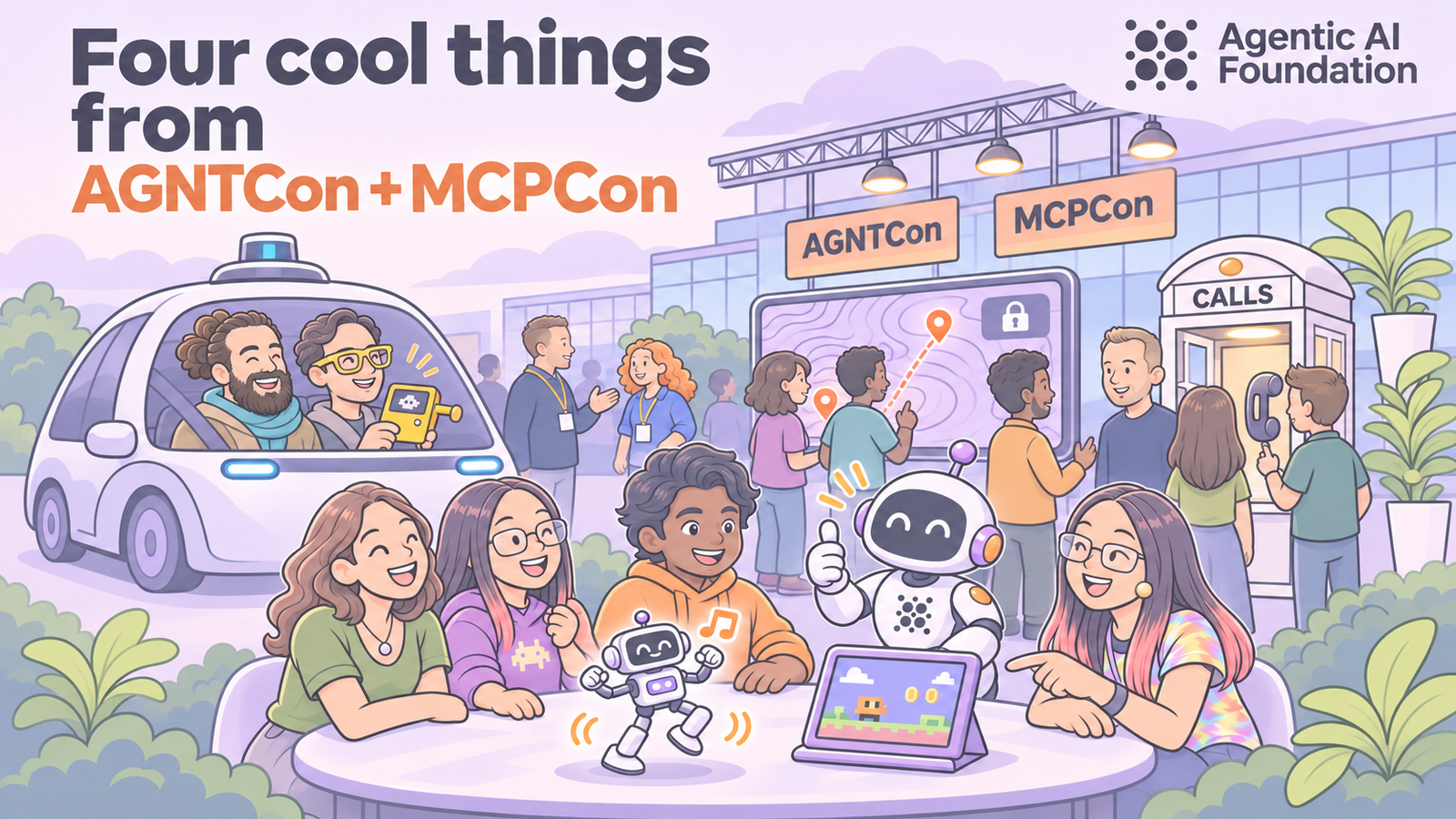

AAIF announced four new projects on day one of AGNTCon + MCPCon North America: Agent Skills, Open Responses, OpenEnv, and OpenSandbox.
Here are four more things that made the event cool.
Slides that stay with you
Like your first PR getting merged or your side project getting mentioned on Hacker News, a good set of conference slides can stay with you. During his talk on MCP’s authorization history, Den Delimarsky gave us a set worth remembering with his topographic map design.
The maps helped explain how MCP changed the way apps get permission to connect to servers. Each server could initially have its own approach, giving an app several different routes to navigate. As Den explained the move toward a common approach, those routes began to share a path.
That common approach was OAuth 2.1. The next step was separating the authorization server from the MCP server, so the authorization server handles access and the MCP server provides the tools. You could follow the technical changes through the maps, which made the design useful as well as good to look at.
A great talk with great visuals, and you don’t need a map to find it. Just follow the link below.
Watch Den Delimarsky’s talk on MCP authorization
Building for the future
Along with agents, we believe the children are the future, so there was Kids’ Day to teach them well. With game development taught by Kaitlyn Hornbuckle and a session led by Cassandra Chin using goose, one of AAIF’s founding projects, to get mBot2 robots dancing, the younger builders had plenty to work with.
For a glimpse of how it went, Shashi Jagtap shared a LinkedIn post about his son presenting a game he’d made in around 15 minutes, and the audience gave him a great reaction. It’s always good seeing kids building and having the chance to show everyone what they’ve made, and hopefully it inspired the next generation of keynote speakers.
Coding consoles and conversations in cars
It wasn’t just the kids who talked about coding and games, as viewers on the live stream saw in Jesse Vincent’s conversation with Demetrios Brinkmann. During the ride in the back of a Waymo, Jesse, an open source developer with 30 years of experience, talked about running a coding interface on a Playdate, the tiny handheld console with a crank.
A friend had floated the idea and Jesse ran with it, putting together an interface through which he could talk to his coding agent.
The lack of a proper keyboard called for some inventive choices. A button handled voice dictation, while an audio chirp transferred connection details instead of making him type out an address and cryptographic key.
On whether it was a practical way to code, Jesse was quite blunt: “It is not actually a wonderful device for this.” But it is a cool side project!
Watch the full interview with Jesse Vincent
Good call
As with any conference, people spent the time between talks getting coffee and seeing what everyone else was working on. There was also plenty to do on the floor for anyone who wanted a break from the schedule, with Pac-Man for quick reflexes and Jenga for steady hands.
For anyone who needed a conversation starter, there was a telephone booth with a phone book full of questions. Some asked people to share their own experiences, such as “What did a teammate teach you that you still use today?” Anyone who picked “What do you hope we get right about AI?” had a fairly big topic to tackle during a coffee break.
You can see more in the Day 2 floor tour, including a stop at the phone booth. With so many people building things in one place, the breaks are a good time to hear about some of them. You might meet someone working through the same problem as you, or end up talking about something you’d never have found on the schedule.
Thanks to everyone who came to San Jose and made it such a good event. We’re already looking forward to the cool things we’ll see at the next one in San Francisco in April 2027.
Share
Author