


A deep dive into Meghana Somasundara and Rush Tehrani’s talk at MCP Dev Summit North America 2026
60,000.That’s how many AI agent executions run inside Uber every single week. More than 1,500 agents are active monthly. Over 90% of Uber’s 5,000-plus engineers use AI tooling every month. And the infrastructure underneath all of it runs on MCP.
“MCPs are not just important,” Meghana Somasundara said. “They are what make AI usable at Uber.”
When Scale Makes Every Problem Worse
Uber didn’t start with a clean slate. The company has over 10,000 internal services, each with its own APIs, data models, and access patterns. Before MCP, every agent team had to figure out on its own how to connect to any of them. The result was hundreds of bespoke, non-reusable integrations built in parallel, with no shared standards and no shared tooling.
At low volumes, that’s messy. At Uber’s volume, it became dangerous.
“Agents move faster and break things faster,” Somasundara noted. “The blast radius is a lot higher.”
Three problem categories crystallized quickly:
- The development lifecycle: no standard way to build or deploy MCP servers
- Security and privacy: no visibility into call patterns or data access
- Discovery: no way for an agent or engineer to find a vetted, reliable tool
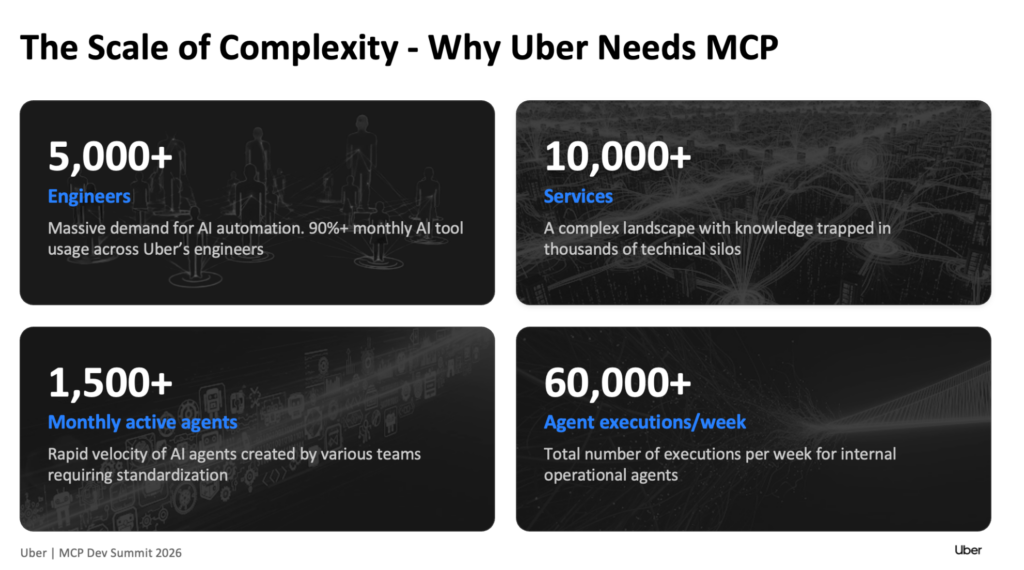
From Meghana Somasundara and Rush Tehrani’s talk at MCP Dev Summit 2026.
Building a Control Plane: MCP Gateway and Registry
Uber’s solution was to treat MCP infrastructure the way it treats any other critical platform: build a control plane.
The MCP Gateway and Registry sits between every agent and every service at Uber. Rather than having teams write their own integrations, the gateway automatically translates Uber’s 10,000-plus service interface definitions (proto and thrift files) into MCP tool descriptions using an LLM. Service owners stay in control of which tools get exposed and can refine the descriptions, but the heavy lifting is handled centrally.
Everything runs through code. Changes become pull requests. Pull requests go through security scanning before they’re deployed. Nothing reaches production through a side door.
The security layer is built in at every level:
- Authentication is on by default for any sensitive data.
- A PII redactor service automatically strips personal information from tool outputs.
- Continuous code scanning catches risky patterns and accidental endpoint exposures.
- Guardrails block write operations to critical services and log everything that gets through.
Third-party MCPs go through stricter gating than internal ones. Uber uses a lot of external systems, and the team wanted to account for different data handling standards across vendors.
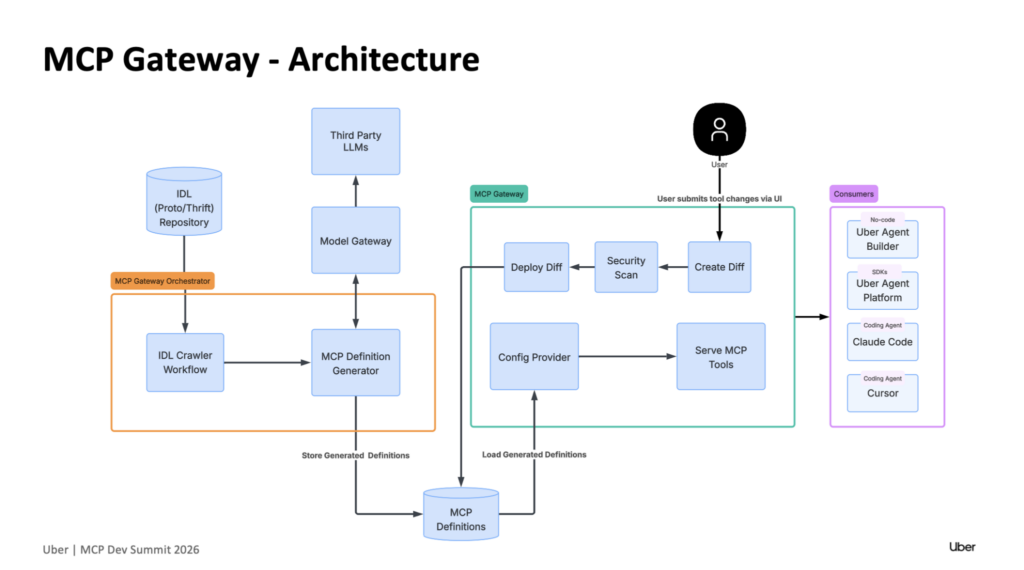
The MCP Gateway architecture, showing how the orchestrator, gateway service, and consumers connect.
Three Surfaces, One Registry
MCPs at Uber flow through three main consumption surfaces, each with different requirements.
Uber Agent Builder is a no-code platform for building internal agents. Teams use it for productivity workflows, automations, and operational tooling. Thousands of agents are active on it monthly. The team built in several reliability improvements: agents can reference a specific MCP server by name in system instructions, operators can select individual tools from a server rather than exposing everything, and specific parameters can be overridden with static values so the model doesn’t have to guess.
Uber Agent SDK is the code-first path for teams building production-grade agents. A YAML config file handles MCP server selection, tool scoping, and parameter overrides. The SDK loads everything automatically. The grocery assistant, care coordination, and customer support agents all run on this stack.
Coding agents Claude Code, Cursor, and Uber’s own background agent Minions, use a CLI tool called AIFX to add local or remote MCP servers. Minions alone produces roughly 1,800 code changes a week and is used by 95% of engineers at the company.
What Comes Next: Quality and Discovery
The roadmap Rush Tehrani presented at the end of the talk focuses on two things: making the registry smarter about quality, and making discovery automatic.
The team is extending the registry to include evaluation metrics and service SLAs, so agents and engineers can see which MCP servers are reliable before picking them. A tool-search tool is in development, an MCP that finds and loads other MCPs on demand, which also helps reduce context bloat.
Skills are becoming a bigger part of the picture too. Tehrani described them as “recipes for using MCPs”, reusable bundles of workflow knowledge that can be shared across teams. The roadmap includes a Skills Registry, plus the ability to evaluate skill outputs, score invocation correctness, and A/B test skill versions against each other.
A Model for Production-Grade MCP Deployment
What Uber built It’s an argument for what it actually takes to run agents in production at a company with real stakes.
The MCP Gateway and Registry pattern (centralized generation, code-driven changes, layered security, tiered trust for internal vs. external servers) is reproducible. Other organizations operating at scale face the same pressures Uber did: fragmented integrations, invisible data flows, and agents that move faster than the humans trying to govern them.
The answer Uber landed on is a control plane. Not because it’s elegant, but because it works.
Meghana Somasundara is the Agentic AI Lead at Uber. Rush Tehrani is Head of Agentic AI Platform at Uber. To learn more about MCP and connect with engineers building at this scale, visit aaif.io, join the conversation in the AAIF Discord or find us at an upcoming AAIF event.