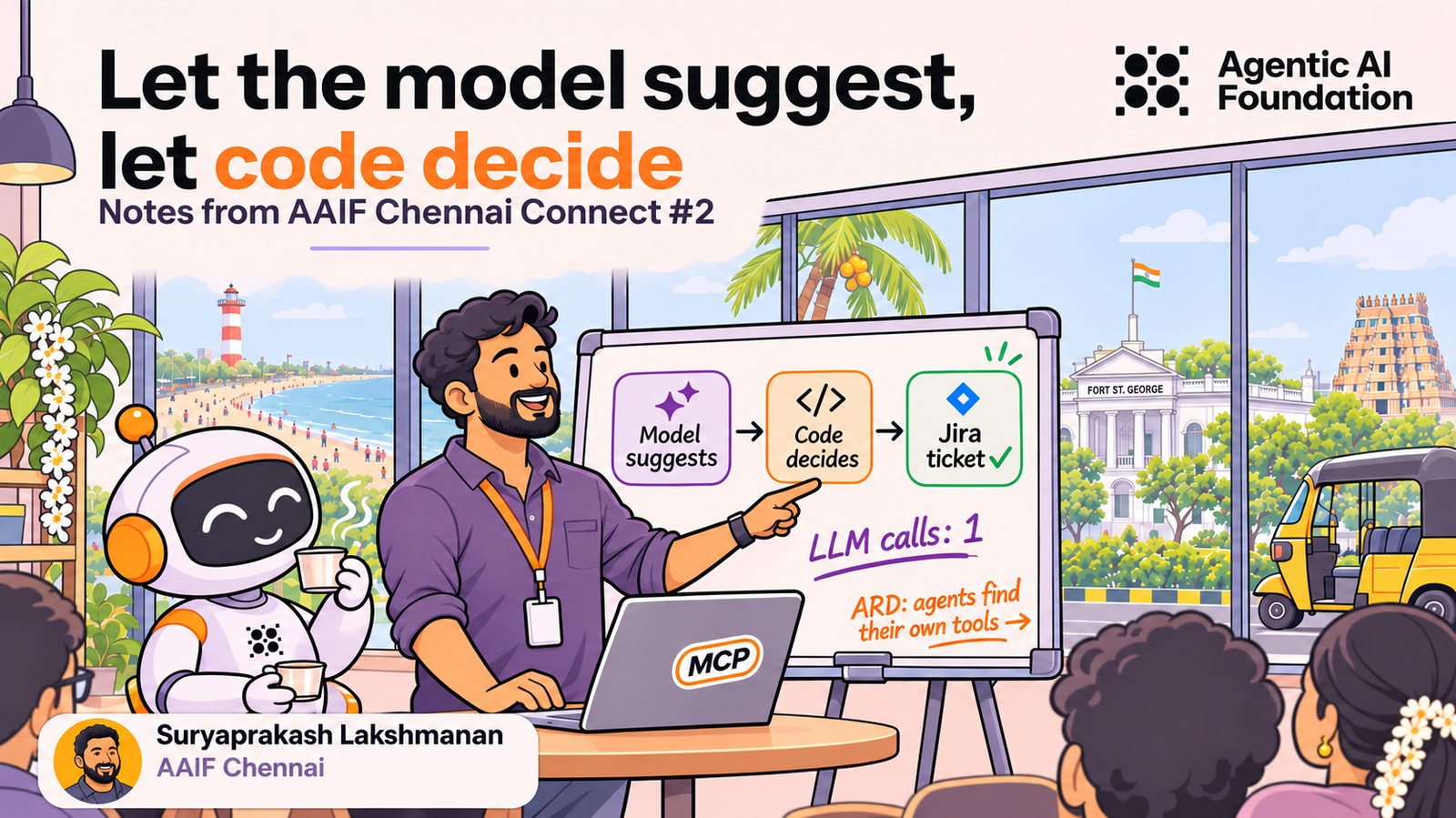

On Saturday, 24 October 2026, about 75 people came to YuniQ in Taramani, Chennai, for Agentic AI Day, the second AAIF Chennai Connect and the chapter's first standalone event. The brief for the afternoon was practical: how people are building and running agents in production.
Five speakers covered the foundation itself, tool discovery, multi-agent consistency, build-failure triage and the new stateless MCP spec. The problems were different, but a few clear judgments came out of the room.
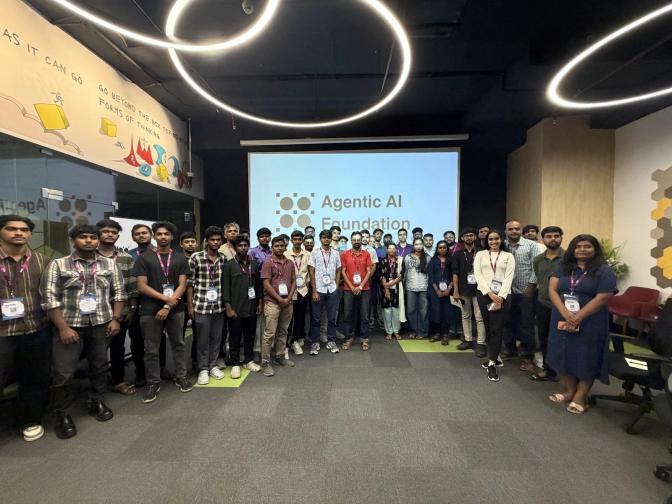
Attendees at AAIF Chennai Connect #2 at YuniQ, Taramani, on 24 October 2026.
Start with the stack
Dr. Shriram Vasudevan, AAIF Ambassador, joined virtually and opened the day. He walked through what the Agentic AI Foundation is, what it hosts, and how projects like MCP, AGENTS.md, goose, A2A and agentgateway fit together as one stack rather than as separate tools.
Most people in the room knew MCP. Fewer knew how the rest of the projects connect to it. Shriram's talk gave everyone the same map before the production talks started.
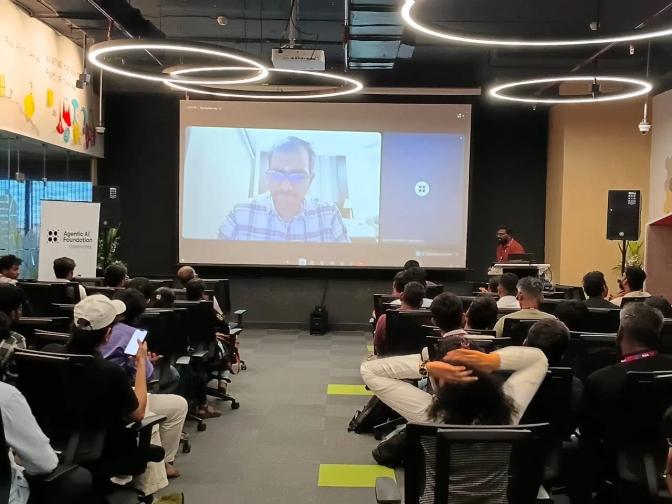
Dr. Shriram Vasudevan joining virtually to open the day.
Agree on meaning before adding agents
Swetha Ashok (Sahaj Software) described a multi-agent system where every agent did its own job correctly and the final answer was still wrong. The agents disagreed about what the user meant.
Her team's fix was not more orchestration. They added an intent router and a shared semantic layer, and tracked each turn as a Q·A·T triplet: the query, a summary of the answer, and the topic diff. Deterministic checks sit on top of that.
Her rule of thumb was the line many people wrote down: the model proposes meaning, code decides what becomes true. She also showed where deterministic checks worked and where an LLM helped.
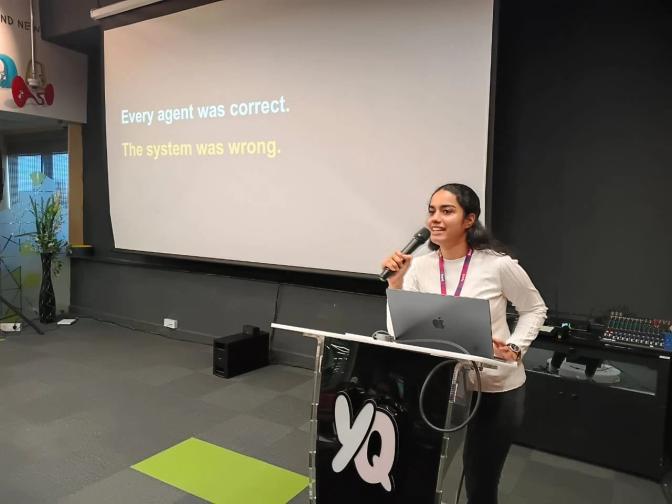
Swetha Ashok: "Every agent was correct. The system was wrong."
Call the model once, at the end
Prabhaharan NM broke a real CI pipeline live on stage. His MCP-based RCA system picked up the failure, worked out the root cause, and raised a Jira ticket for the right owner in about 20 seconds. The ticket closes itself when the build turns green.
The design choice behind it: plain code decides which MCP tools to call and in what order. The LLM is called once, at the very end, to explain the failure in plain language. That keeps cost low and behaviour predictable, which matters for something that runs on every failed build.
Two talks, two unrelated problems, same conclusion. Let the model suggest, and let plain code decide.
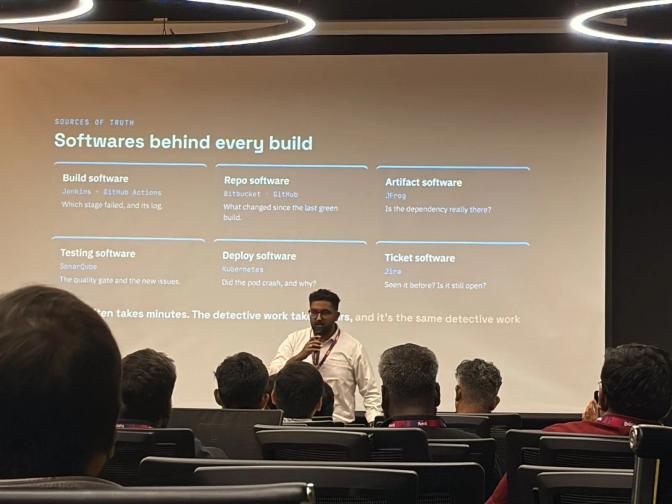
Prabhaharan NM on the tools behind every build.
Give agents room to find their own tools
Shaan Narendran took the other side. He introduced ARD (Agentic Resource Discovery) and showed how he built it into Observal, so agents can discover the tools and resources they need at runtime instead of having each one wired in by hand. His one-liner: MCP is how agents talk to tools; ARD is how they find them.
Coming after two talks about keeping the model on a short leash, this made for a useful tension. The question people kept coming back to in Q&A was where the line sits: which decisions to hand to the agent, and which to keep in code.
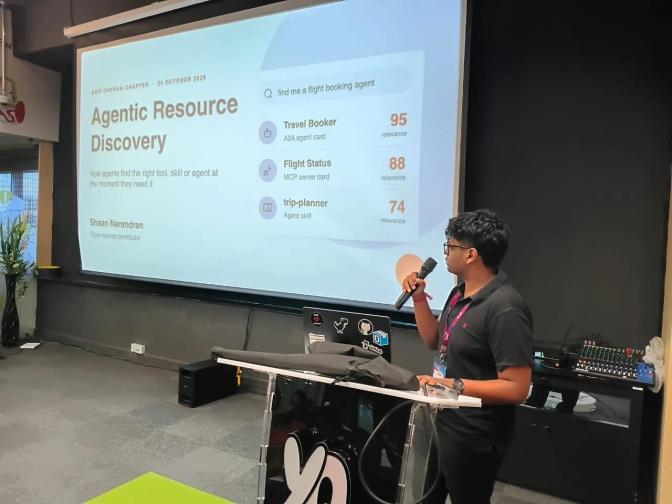
Shaan Narendran introducing Agentic Resource Discovery.
Stateless MCP and failures that stay green
Akash Sathish, AAIF Ambassador, closed the day with "Sessions are dead. Now what breaks?" He walked through the stateless MCP spec released on 28 July and what it changes for server maintainers.
Running a server across eight pods, he showed the kind of failure that worries him most: nothing throws, and the dashboards stay green. He finished with migration patterns for maintainers moving off session state.
It was also the liveliest session of the day. The animations and a Jailer 2 Thalaivar reference had the whole room hooked.
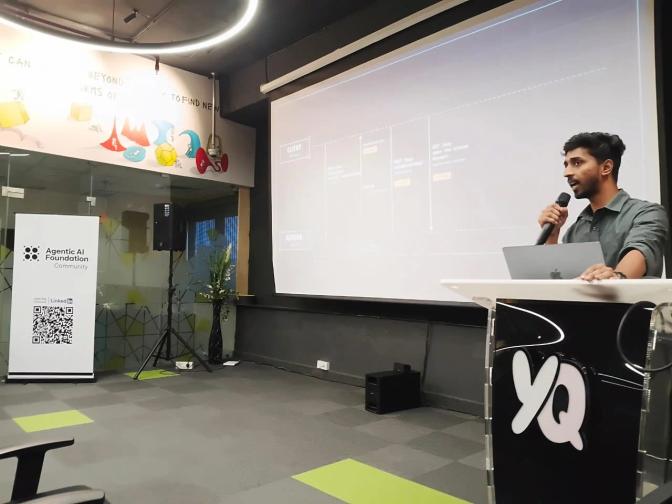
Akash Sathish closing the day on stateless MCP.
What we're taking away
No one in the room argued that agents should do everything, and no one argued they should do nothing. The useful part was seeing real systems make that call in different places. Swetha and Prabhaharan put the model behind deterministic code. Shaan gave agents more room to find what they need. Akash showed what goes quietly wrong in the protocol layer underneath all of it.
Thank you to YuniQ for hosting us and taking care of everyone, and to the organizing team: Subramania Raja, Akash Sathish, Harish P and Manoj Kumar S. And thanks to everyone who came out, asked questions and stayed back to talk.
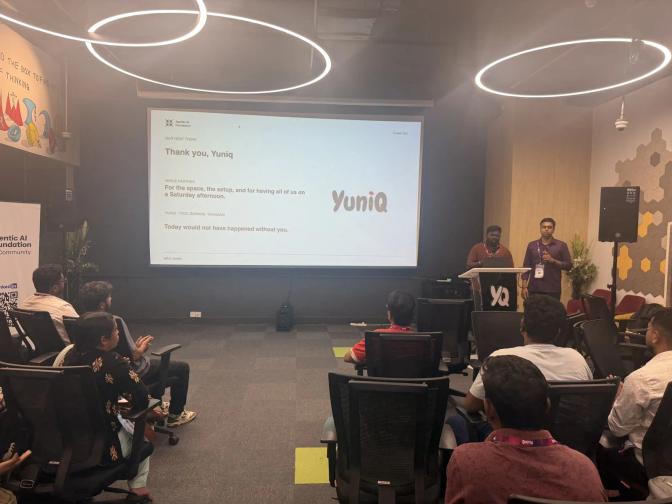
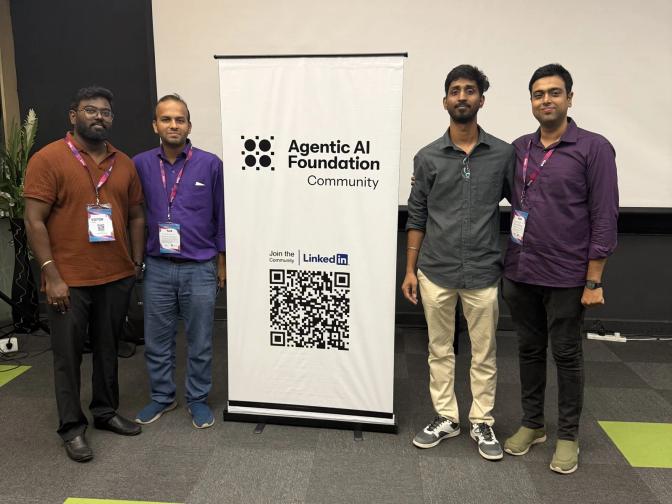
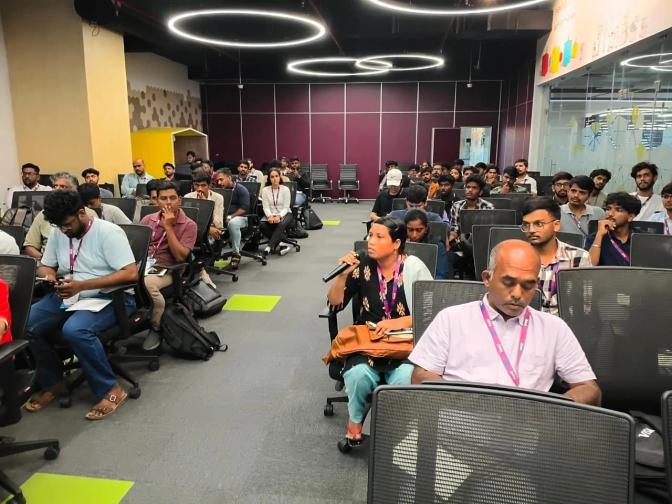
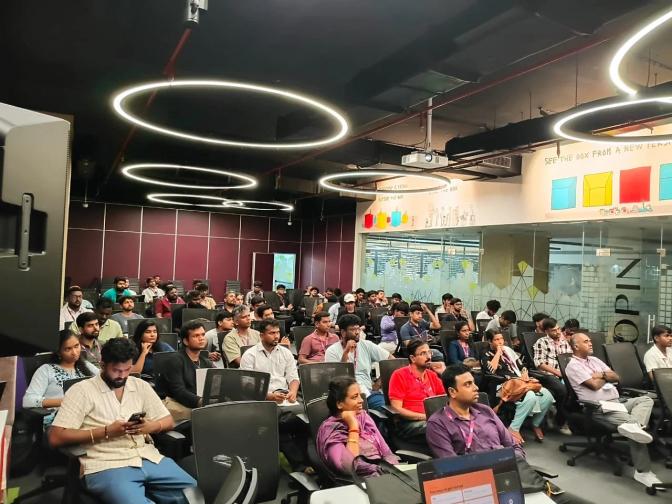
A packed room, questions from the floor, the organizing team, and a thank-you to YuniQ.
Speak at the next Connect
AAIF Chennai meets regularly, and we want more talks from people building with MCP, goose, A2A, AGENTS.md, agentgateway or any of the AAIF projects. The format is mostly talks and sessions focused on production experiences, including what went wrong.
- Submit a talk: Call for speakers
- Hear about the next event first: AAIF Chennai on Luma
- Follow AAIF Community Chennai on LinkedIn
Share
Author

Suryaprakash Lakshmanan
Staff Engineer at PayPal and AAIF Chennai community organizer, specializing in AI platforms, MCP and cloud infrastructure.
View All Posts