
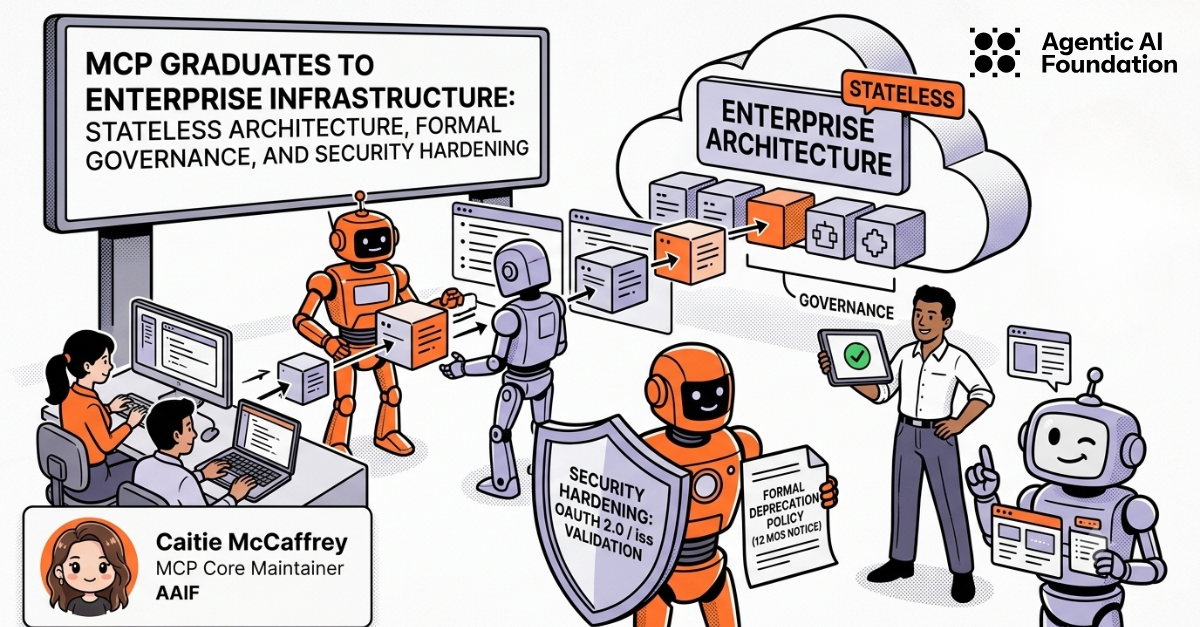

The largest update to the protocol since launch removes core scaling bottlenecks, adding first class extensions, hardening authentication and adding a formal deprecation policy to make agentic AI ready for the Fortune 500
For the past year, the Model Context Protocol (MCP) has become the standard method for connecting AI agents to external tools, data, and applications. Since Anthropic open-sourced the protocol in November 2024, adoption has exploded across dozens of published MCP servers and major AI platforms.
But moving agentic AI out of the prototype phase and into massive production environments has consistently hit the same operational walls. Large-scale deployments require the simplicity and scalability of stateless cloud native infrastructure, and enterprise teams need to know that what they build today won't break tomorrow.
To address these hurdles head-on, a major update to MCP has been released. Representing the largest revision of the protocol since its initial launch, this release removes the core scaling bottlenecks, finalizes the project's transition to a stateless architecture, and establishes the formal governance and security hardening required for enterprise-scale deployments.
The Core Bottleneck: From Sticky Routing to Stateless Scale
Historically, running MCP at scale required sticky routing or shared state to maintain continuity across sessions. This made large-scale production deployments complex to implement and operate even when the capabilities being exposed were stateless.
Building on feedback from the community of builders creating MCP Hosts & Clients, the Core maintainers met in December 2025 to lay out the foundational changes the protocol needed in the Future of MCP Transports. This update officially finalizes MCP's transition to a completely stateless architecture. By shifting to a stateless model, organizations can now run MCP servers behind standard load balancers using the existing Kubernetes and cloud-native DevOps tools they already rely on.
This completely removes the operational friction of managing session state, allowing teams to treat MCP servers like ordinary, highly scalable HTTP services.
Predictable and Stable: Establishing Enterprise Governance
When enterprises adopt an open protocol at scale, they need a clear guarantee of stability. They cannot afford silent breakages or sudden architectural shifts.
To bring mature, internet-standard predictability to the ecosystem, this release introduces a Formal Deprecation Policy alongside a new Extensions framework. Under the new policy, developers are guaranteed a minimum window of twelve months between a feature's formal deprecation and its earliest possible removal. This ensures that enterprise engineering teams can build against the MCP specification with total confidence.
Closing the Loop on Security: Hardened Authorization
Because of MCP's typical single-client, many-server deployment pattern, it faces unique security vectors and policy enforcement challenges for security teams.
This release includes significant authorization hardening changes to address security issues by aligning the MCP auth spec with how OAuth 2.0 and OpenID Connect are deployed in practice. Crucially, the protocol now enforces the mandatory validation of the iss parameter. This protocol-level defense closes an entire class of mix-up attacks, ensuring secure identity and context delegation across distributed environments.
Additionally the Enterprise Managed Authorization allows organizations to centrally manage authorization for MCP Servers, and simplifies the login experience for end-users by making the organization's IdP the authoritative decision-maker for MCP server access.
Beyond Text: Interactive Server-Rendered Interfaces
In addition to core architectural and security improvements, the update expands what AI agents can actually deliver back to users. MCP Apps can now ship their own server-rendered, interactive interfaces.
MCP Apps is an official protocol extension, which allows it to evolve independently of the core specification release cycle. MCP Apps allows developers to deploy rich, interactive user experiences natively from their own servers. This dramatically accelerates the development lifecycle for feature-rich, user-facing agentic applications.
Beyond Request Response: Tasks for Long Running Operations
Not every tool call finishes in a single round trip. Expensive computations, batch jobs, and other long-running tool calls don't fit the request-response model. MCP Tasks let servers return a durable handle instead of blocking, so clients can poll for progress, provide input when needed, and retrieve the final result after reconnecting.
The payoff is operational resilience at scale. Because a task is durable and addressed by a stable handle, clients can persist task IDs to durable storage so that polling can resume after a crash or restart — no fragile, long-lived connections held open waiting for work to finish, which the old blocking model forced on clients and servers that did not want to implement it.
MCP Tasks has graduated from an experimental feature to an official extension to provide a common way of supporting async long running operations.
Looking Ahead: The Next Phase of Open Standards
Since being contributed to the AAIF under the Linux Foundation in December 2025, MCP's mission has been to establish open, vendor-neutral standards for AI agent communication. This latest update represents the critical bridge between experimental agentic loops and production infrastructure.
If your organization is ready to move beyond isolated AI pilots and build scalable, resilient agentic networks, we invite you to get involved with the next phase of MCP's development. Join the AAIF community and collaborate with the engineering teams shaping this infrastructure face-to-face at our upcoming events:
- AGNTCon + MCPCon China – September 6-7 | Shanghai, China
- AGNTCon + MCPCon Japan – September 10-11 | Tokyo, Japan
- AGNTCon + MCPCon Europe – September 17-18 | Amsterdam, Netherlands
- AGNTCon + MCPCon North America – October 22-23 | San Jose, California
Share
Author

Caitie McCaffrey
Caitie McCaffrey is a Software Engineer at Microsoft building agentic platforms and developer tools. She’s a Core Maintainer on MCP. Caitie has spent her career building large-scale distributed systems and services across multiple domains, including gaming, social media, and IoT.