
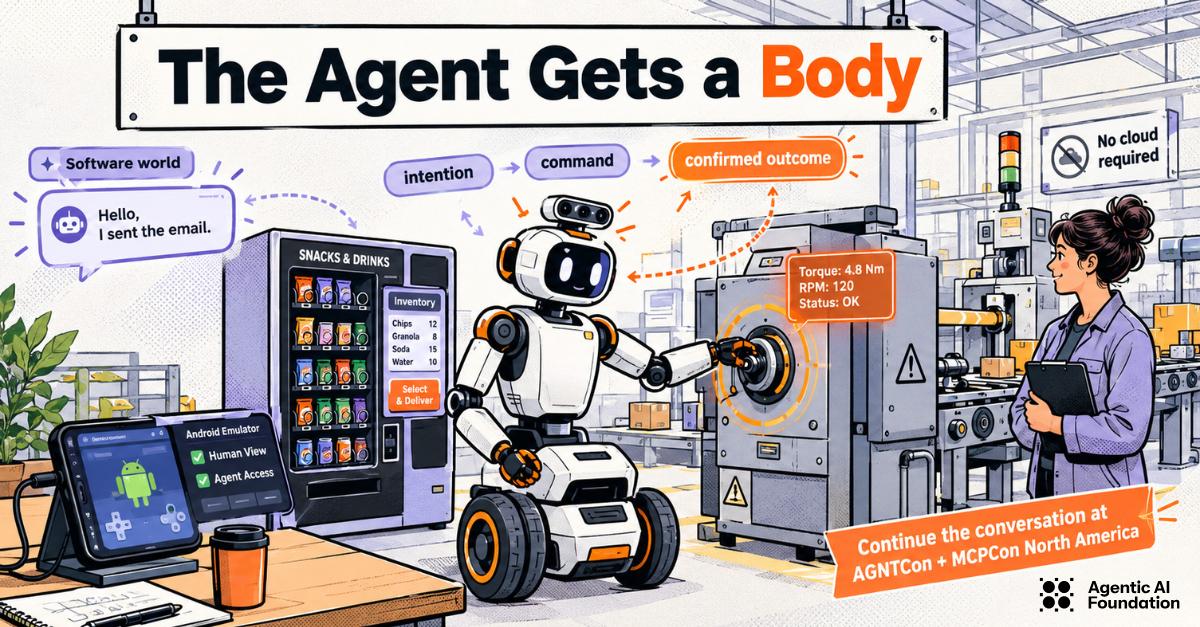

Giving an agent access to email is useful. Giving it access to a motor is clarifying. A hallucinated email can be embarrassing. A hallucinated motor command has excellent feedback characteristics.
The physical world forces agent builders to confront assumptions that software kindly lets them ignore. Devices come and go. Networks disappear. Actions have momentum. The agent needs to know which machine it is controlling, whether the command arrived and what actually happened afterward. “The tool call returned 200” is not much of a safety case when something has wheels.
Alexander Tsyplikhin’s Arm session tackles the missing last mile between an MCP call and a physical fleet. MCP and A2A can help an agent invoke software, but they do not by themselves let it discover devices and control them across different transports. Device Connect gives hardware a way to advertise capabilities and receive network RPC calls, including a device-to-device mode without a broker or cloud. The live demo turns a plain-English request into discovery and movement on real hardware.
Amazon’s “Hand the Agent the Clicker” looks lighter but reveals the same design principle. Its Porthole project streams Android and Android TV emulators into a browser for a human while exposing the same controls to an agent over MCP. The browser, CLI and MCP server are thin surfaces over one set of observable primitives. That last word matters. Agents call the inspection tools constantly because they need to verify what their action did.
GlobalLogic takes the pattern into environments where “just call the cloud” is not a serious plan: smart factories, offshore oil rigs and cargo ships. Its stack runs stateful agents on the plant floor in an air-gapped environment, with orchestration, identity and observability designed for 24/7 operation and to keep telemetry within the environment. Physical agents are edge systems before they are clever assistants.
The most charming version of this experiment may be a vending machine. At AGNTCon + MCPCon Europe, Floris Fok of Prosus uses one as a testbed for an autonomous organization operating under real customer demand. The inventory is small, the transactions are real and every bad decision becomes visible quickly. It is difficult to imagine a better laboratory for finding out whether an agent can run a business—or merely explain how one works.
Agents are beginning to leave the chatbox. Giving them bodies will make them more useful, but it will also make the difference between intention, command and confirmed outcome impossible to wave away.
Continue the conversation
- From MCP Tool-Call to Motor Command with Alexander Tsyplikhin, Arm
- Hand the Agent the Clicker with Giovanni Laquidara, Amazon
- Mission-Critical AI in Extreme Environments with Georgy Okrokvertskhov, GlobalLogic
- Autonomous Organisations: Starting Small with Floris Fok, Prosus, at AGNTCon + MCPCon Europe
AGNTCon + MCPCon North America takes place Oct. 22–23 in San Jose. Register and use OUTREACH25 to save 25%.
Share
Author

Alex Salkever
View All PostsAlex Salkever is the Editor-in-Chief of the AAIF and the Linux Foundation. He has been working in open source storytelling for over a decade and formerly served as a CMO and VP at a number of technology companies. He started his career in journalism, ultimately working as the technology editor for Bloomberg BusinessWeek. He leads efforts to build the AAIF media engine to drive awareness and education.