

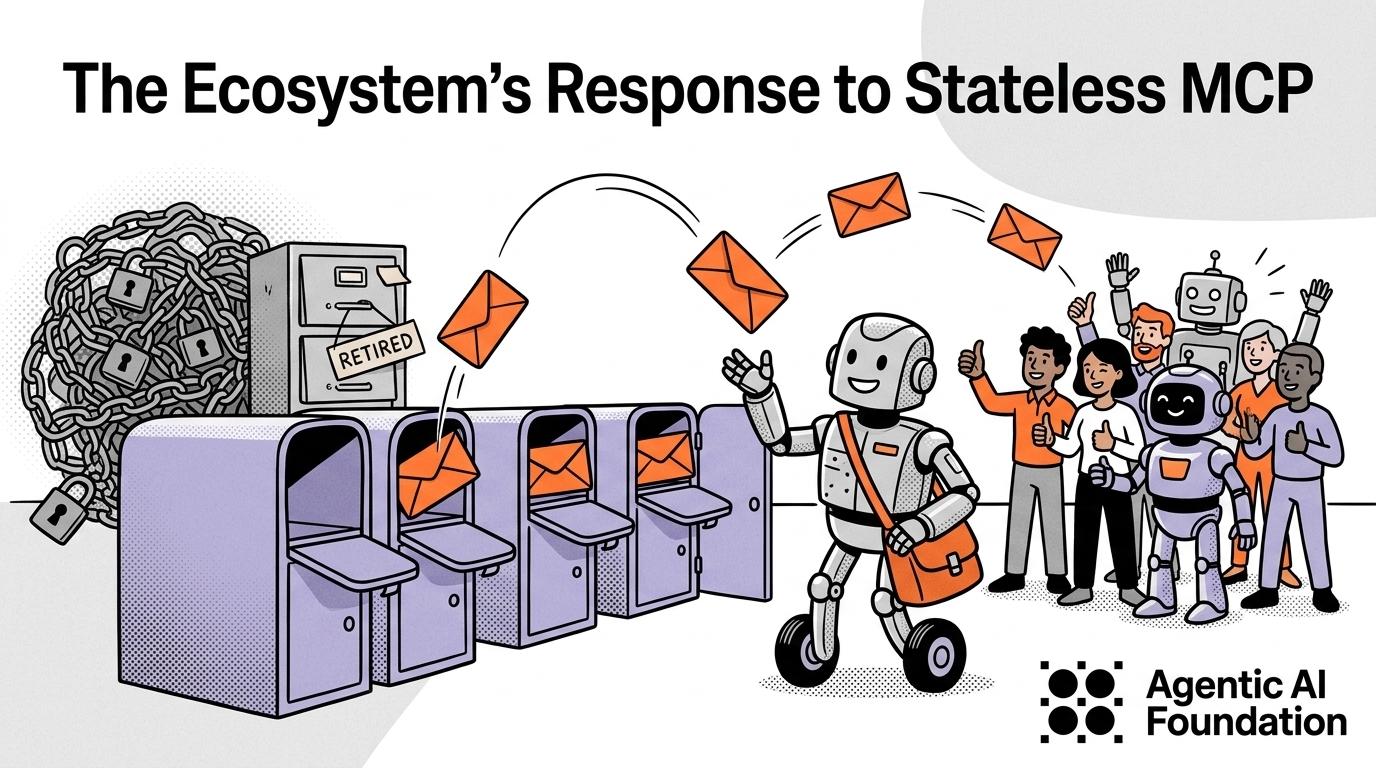


Within days of the MCP 2026-07-28 specification release, infrastructure providers, SDK maintainers, cloud platforms, and tool vendors had announced support, published migration guidance, and shipped production implementations. For an open standard, adoption within days is unusually fast.
The main change is that MCP no longer requires protocol sessions, so every request is independent and carries its protocol version, client identity, and capabilities with it. Servers no longer need sticky sessions or shared session stores to scale horizontally. An MCP server now behaves like any other HTTP service. Any request can land on any server instance behind a plain round-robin load balancer, and method and tool names travel in HTTP headers, so gateways can route and rate limit without parsing request bodies. For anyone running MCP beyond a laptop, running servers becomes simpler and cheaper.
The vendors who run MCP at scale moved first, and their changelogs show exactly what the change bought them. GitHub updated its MCP Server before the specification officially shipped and described three changes:
- It removed Redis backed session storage, which eliminated a database write on every
initializecall and a database read on every request. - It stopped inspecting the payload of every request, because the values it needs for logging and secret scanning now arrive in HTTP headers that the specification guarantees.
- It reworked its login flow so that each step runs as a separate HTTP request, with an SDK wrapper that keeps older clients working.
GitHub also noted that all four tier 1 SDKs kept backward compatibility, so most server authors do not need to change anything to stay connected.
Cloudflare had a similar story on day one. Each request to its MCP servers now runs on a fresh stateless server with no protocol session and no protocol-specific Durable Object, and most existing clients reconnect without any configuration changes.
Manufact, which hosts thousands of MCP servers, reported that the new SDK cut its package size by about 83 percent and made it 25 percent faster, and that going stateless let it handle production traffic without infrastructure workarounds.
Arcade spent weeks preparing customers with migration guides, webinars, and technical articles that explained what would change, what would break, and why the stateless design simplifies production deployments.
Several companies also shared statements in the release announcement about what the change unlocks for their platforms and customers.
Supabase runs its MCP server statelessly, so it could never support elicitation, which previously required a held-open connection. The new multi round-trip request design lets its tools pause mid-call and confirm with the user, e.g., the cost of a new project before it is created or a query that would delete data.
AWS made the stateless core available in Amazon Bedrock AgentCore, so developers can deploy MCP servers on standard scalable infrastructure without managing sessions or persistent connections, and it contributed the Tasks extension for long-running agents.
PostHog noted how statelessness makes it easier to scale its own service and to add analytics that show customers how their MCP tools are being used.
MCP's new release enables Microsoft's Foundry to scale from dozens of integrations to thousands while centralizing governance and identity.
The platform statements went beyond feature announcements. Google Cloud described the release as "a massive leap forward in enterprise AI scalability", and Netlify said the stateless core was what customers had been waiting for to make MCP workloads work like the rest of the platform.
Stacklok had already implemented the revision and noticed that the stateless model removes operational complexity at enterprise scale.
These companies did not react months later. They had implementations, products, and messaging ready when the specification landed.
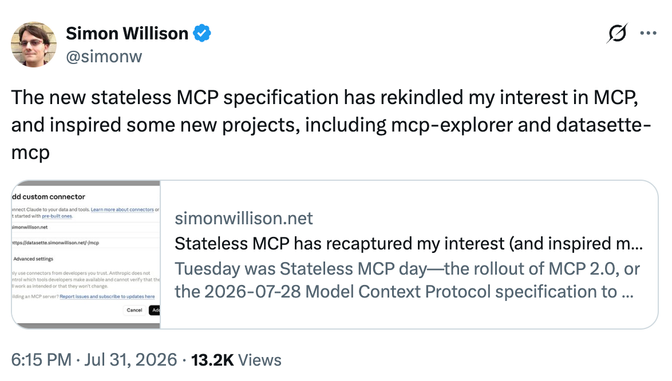
Independent developers moved just as quickly. Simon Willison began building against the new protocol right away. He released new tooling and wrote that stateless MCP had "recaptured my interest". Independent developers often give an early signal of where a standard is heading, so when experienced builders rewrite tooling within days, the new model probably improves the developer experience.
Protocol revisions are common, but standards often wait months for SDKs, infrastructure providers, and vendors to catch up. By the end of release week, multiple infrastructure providers, cloud platforms, SDKs, and application vendors had aligned around the new model, and several had features in production that the old protocol made impossible. The speed suggests the stateless design solved problems many organizations were already facing in production. The specification was published, and the ecosystem adopted it almost immediately.
Share
Author