
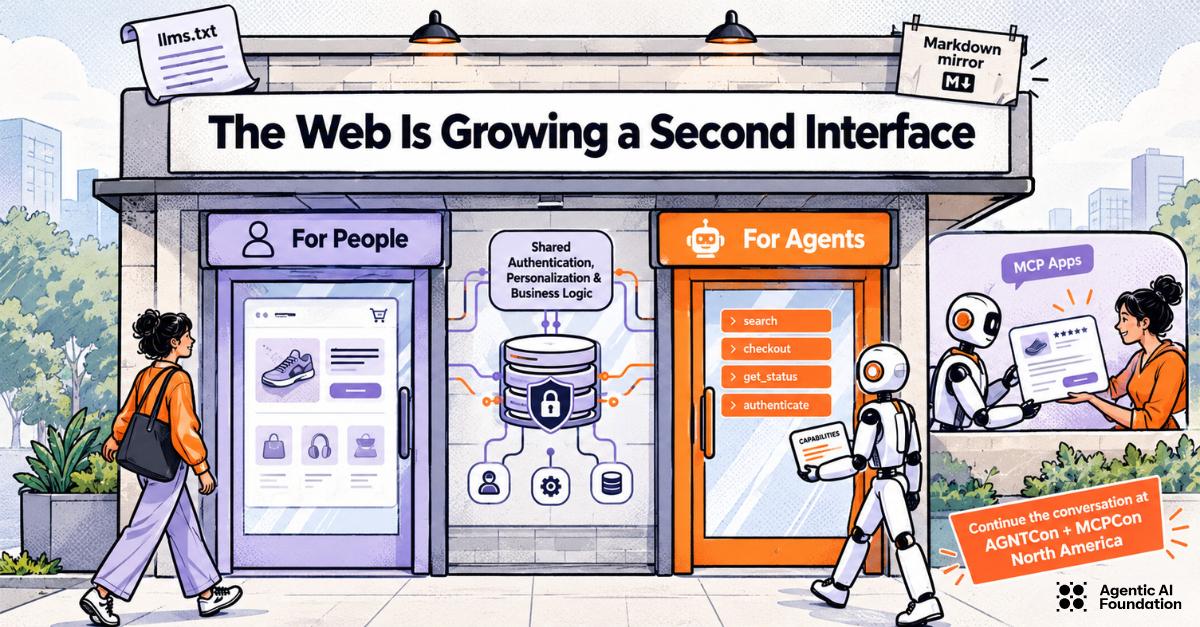

The web has always been full of machines. Search crawlers read it, recommendation systems rank it and scripts move data around behind the scenes. But the web itself was still designed around a person looking at a page. Agents are changing that arrangement. They do not merely want to read the page. They want to discover what the site can do, authenticate, invoke an action and sometimes hand the person a useful interface for the part that should remain human.
Today, agents often attack this problem from the outside. They inspect a page, guess what the controls mean and drive a browser through an interface built for eyes and fingers. It works remarkably well until it does not. A button moves, a label changes or the agent has to reconstruct business logic that the frontend already understands.
WebMCP gives the frontend a more direct way to participate. A site can expose structured, discoverable functions through the page while reusing the authentication, personalization and application logic it already has. The agent still meets the user on the web; it simply no longer has to pretend to be a tiny person clicking every button.
MCP Apps approaches the interface from the other side. An MCP server can return an interactive UI inside the agent experience for visualization, branding and the final choices that are easier to make visually. Dominic Farolino and Liad Yosef bring the two directions together: WebMCP lets the agent operate the site, while MCP Apps lets the service bring an interface back to the agent. Google’s A2UI adds a related model in which agents stream declarative interface descriptions from a controlled component catalog. The agent can assemble a useful UI without being allowed to fling arbitrary executable code across the trust boundary.
This shift also reaches content. Adyen found that AI bots accounted for 11.6% of more than 10 million requests to its documentation site, and most generative-AI traffic came from assistants helping developers with active coding tasks. The company added llms.txt, Markdown URLs and a complete downloadable documentation mirror so agents could retrieve clean source material instead of burning context reconstructing a website.
The web is not becoming agent-only. Quite the opposite. It is growing a second interface alongside the human one, with shared primitives underneath. The best systems will let the agent handle discovery and mechanical work while bringing the person back for judgment, review and the parts that benefit from seeing.
Continue the conversation at AGNTCon + MCPCon North America
- The Agentic Web with Sarah Drasner, Google
- MCP Apps + WebMCP: The Next Era of Interface with Dominic Farolino, Google, and Liad Yosef, MCP Apps
- Generative UI at Scale with A2UI with Alan Blount, Google
- How Agents Really See the Web with Liad Yosef, MCP Apps
- The Frontend Strikes Back with Ryan Roemer, Nearform
- Beyond Scraping: Building Agent-Ready Documentation Layers with Ayodeji Ogundare, Adyen
- Hand the Agent the Clicker with Giovanni Laquidara, Amazon
AGNTCon + MCPCon North America takes place Oct. 22–23 in San Jose. Register and use OUTREACH25 to save 25%.
Share
Author

Alex Salkever
View All PostsAlex Salkever is the Editor-in-Chief of the AAIF and the Linux Foundation. He has been working in open source storytelling for over a decade and formerly served as a CMO and VP at a number of technology companies. He started his career in journalism, ultimately working as the technology editor for Bloomberg BusinessWeek. He leads efforts to build the AAIF media engine to drive awareness and education.