
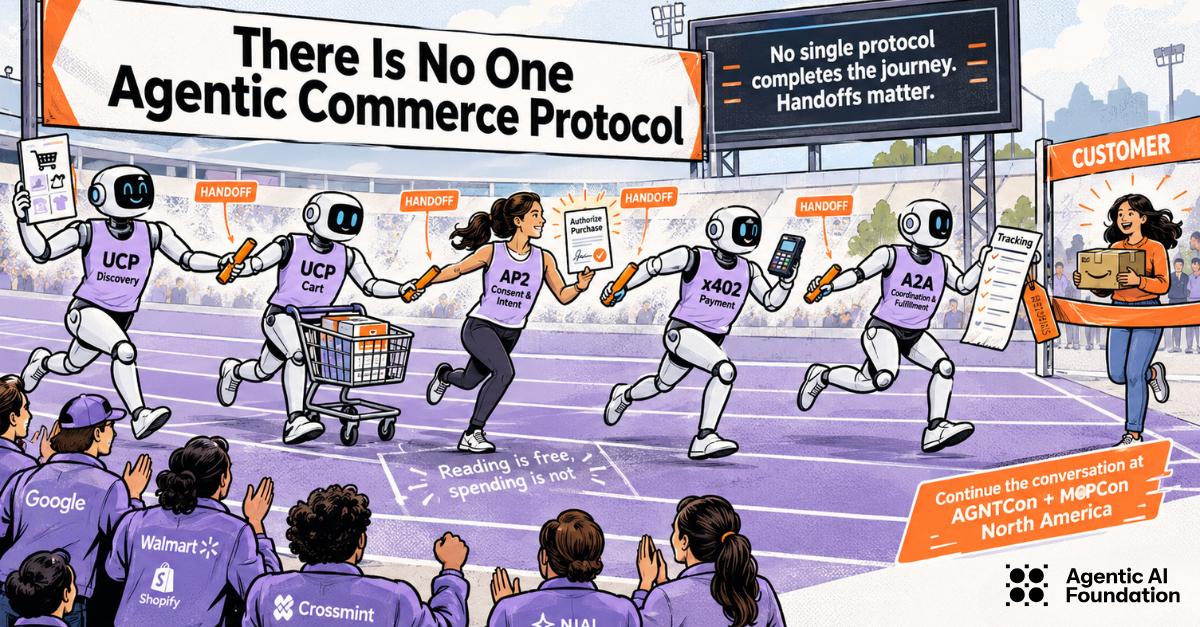

Agentic commerce is often reduced to the satisfying moment when an agent buys something. A complete commerce flow begins there. Somebody has to discover the product, assemble the cart, prove the user’s intent, move the money, confirm the order, track the shipment and handle the return when the agent confidently buys the wrong size.
The emerging protocol landscape reflects those different jobs. UCP gives merchants and platforms a common way to expose commerce capabilities. AP2 focuses on trusted intent and authorization, including the awkward but essential case in which the human is not present when payment happens. x402 uses web-native payments to let software pay for resources and services. A2A lets agents coordinate across systems. Each is useful. None is the entire checkout line.
Google’s UCP and AP2 session shows how the pieces meet across Search, Gemini, YouTube and Gmail. UCP handles discovery and pluggable commerce capabilities, including a universal cart that can travel across surfaces. AP2 adds cryptographic evidence of what the person authorized when an agent acts later. That separation is healthy. Finding a product and proving consent to spend money are not the same problem and should not be entrusted to the same vague blob of context.
Walmart makes the protocol boundaries impossible to ignore by walking one purchase from product discovery through cart management, checkout, payment confirmation, tracking and returns. Its conclusion is usefully undramatic: no single protocol completes the journey. The practical stack will combine protocols and payment rails, with explicit handoffs between them.
Shopify brings the merchant ecosystem into the picture through its work on UCP. Crossmint explores how x402 and A2A fit into real embedded payments. N1AI starts even earlier, probing live ecommerce endpoints with a minimal agent to learn what information is freely readable and where spending authority begins. That boundary between reading and spending may turn out to be one of the most important interfaces in the stack.
Agentic commerce is not one protocol war with a winner at the end. It is a relay race involving discovery, identity, delegated authority, payment and proof. The good news is that the baton passes are finally becoming visible enough to standardize.
Continue the conversation at AGNTCon + MCPCon North America
- Architecting Agentic Commerce: UCP and AP2 with Amit Handa and Prateek Dudeja, Google
- AP2, UCP and So Many Others—But What Completes My Payments? with Muskan Jain, Walmart Global Tech
- Universal Commerce Protocol with Ilya Grigorik, Shopify
- Embedding Agentic Payments with x402, A2A and Other Emerging Protocols with Fede Sarquis, Crossmint
- Reading Is Free, Spending Is Not with Francesco Marinoni Moretto, N1AI
AGNTCon + MCPCon North America takes place Oct. 22–23 in San Jose. Register and use OUTREACH25 to save 25%.
Share
Author

Alex Salkever
View All PostsAlex Salkever is the Editor-in-Chief of the AAIF and the Linux Foundation. He has been working in open source storytelling for over a decade and formerly served as a CMO and VP at a number of technology companies. He started his career in journalism, ultimately working as the technology editor for Bloomberg BusinessWeek. He leads efforts to build the AAIF media engine to drive awareness and education.