



On 23 July 2026, members of the AAIF and CNCF communities met in Shanghai to discuss how current open source projects can support the design of AI-native systems.
Hui Deng, an AAIF Ambassador, opened the meetup with an overview of the AAIF and CNCF AI-native landscapes. Speakers from Ant Group, Alibaba, ZTE, and Huawei then shared their views on agent engineering, infrastructure, and the technical questions emerging as the field develops.
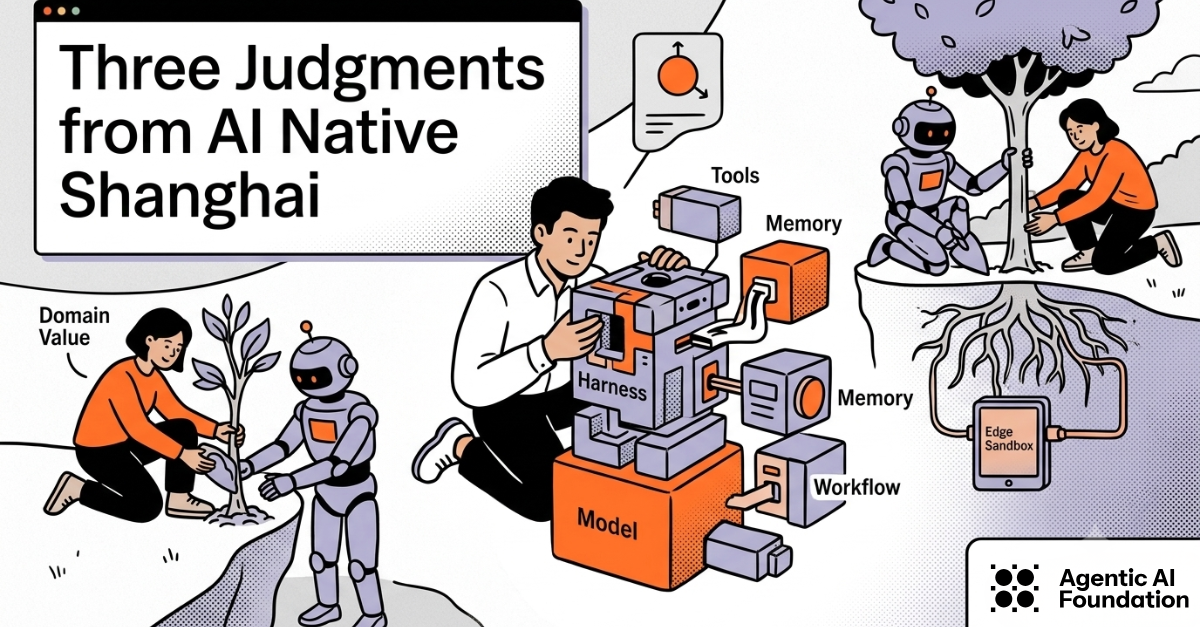
Much of the discussion centered on three judgments about the current agent era.
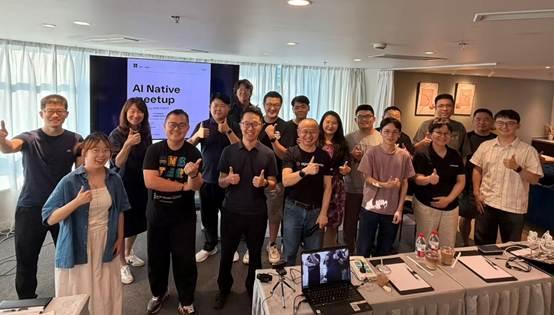
Attendees at the AI Native Shanghai Meetup on 23 July 2026.
Engineering patterns are still forming
The first was that agent engineering remains at an early stage.
Many of the technical patterns, architectures, and operating practices are still being worked out. Rather than optimizing established systems, teams are often designing components and approaches for which there is no accepted implementation path yet.
That gives early projects an opportunity to influence the interfaces, patterns, and conventions that may later become more widely adopted. It also means teams need to evaluate new approaches carefully, rather than assuming that today's implementation choices will become lasting standards.
Model × Harness × Tools
Richard, an AAIF Ambassador at Ant Group, argued that product performance depends on more than selecting the most capable model.
He described it as a combination of:
Model × Harness × Tools
The model remains important, but the harness determines how it is connected to tools, context, memory, workflows, and the surrounding execution environment. Evaluation criteria also shape how teams measure whether the complete system is working as intended.
From this perspective, harness design is one of the most active areas of agent engineering. There is no single established approach, and decisions about orchestration, tool use, context management, and evaluation can have a significant effect on the resulting product.
Value moves closer to the domain
A third judgment concerned what happens as models absorb more public knowledge and general capabilities.
The discussion suggested that domain-specific judgment, business knowledge, and experience in less predictable situations may become increasingly important. These are areas where the correct response may depend on context, operational knowledge, or decisions that cannot be reduced to widely available information.
For teams building agent systems, this places more emphasis on the environments in which agents operate, the knowledge they can access, and the way domain expertise is represented in tools, workflows, and evaluation.
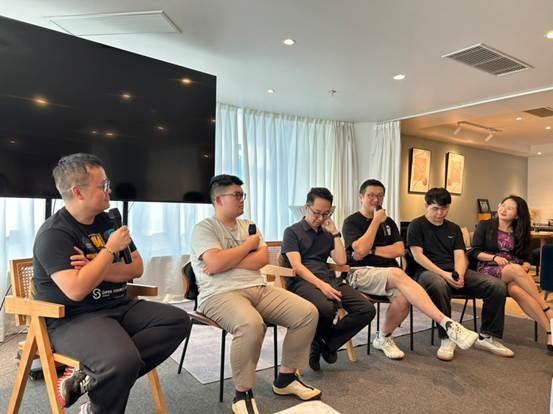
Speakers discuss model, agent design, infrastructure and sandbox design during the meetup.
Rethinking the agent sandbox
Speakers from Alibaba, ZTE, and Huawei also discussed a different role for sandboxes in agent systems.
Rather than treating a sandbox only as virtualization infrastructure, they considered positioning it as a lightweight capability used by the agent itself, particularly on edge devices.
In this model, the sandbox becomes part of the agent environment, providing isolation and execution where required. Future approaches may separate cloud-based and edge-based sandboxes, with each using technologies suited to its own performance, security, and resource constraints.
The discussion also questioned whether agent systems require an entirely new infrastructure layer. Existing cloud-native and open source components may continue to provide much of the underlying foundation, with new isolation and lightweight execution technologies introduced where agent workloads create specific requirements.
A broader view of agent engineering
Across the sessions, a consistent theme was that agent systems are shaped by more than model choice. Harnesses, tools, domain knowledge, execution environments, and sandbox design all influence how these systems are built and evaluated. The meetup gave practitioners a useful setting to compare those approaches and share what they are seeing across China's agent ecosystem.
Share
Author