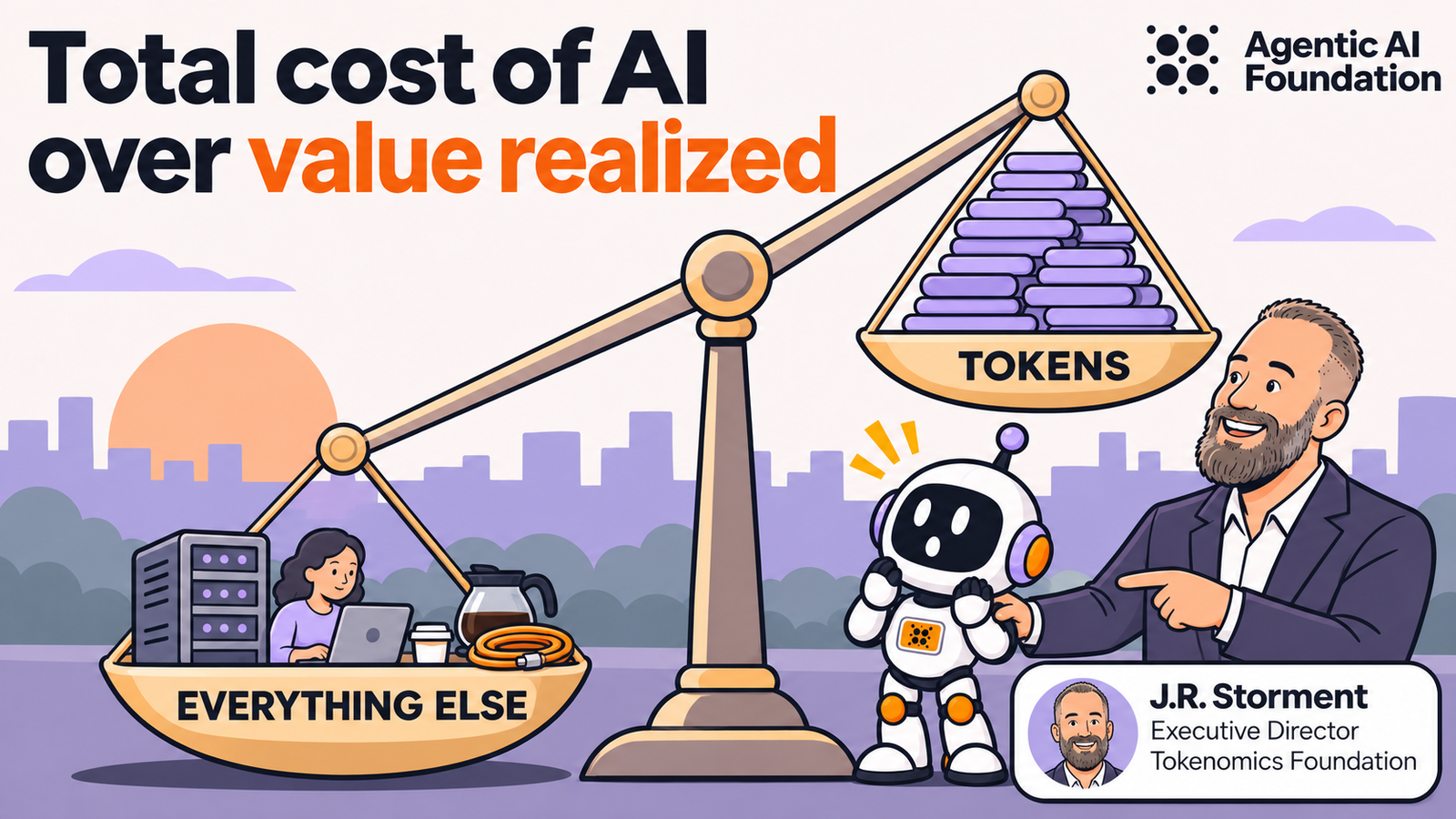

J.R. Storment is Executive Director of the Tokenomics Foundation, a Linux Foundation project.
In one enterprise audit shared with the Tokenomics Foundation this year, direct model consumption came to roughly a quarter of total AI spend. While that proportion will vary between organizations and workloads, token spending accounts for only part of the overall cost of AI. If you run agents in production, you already feel this: the invoice you watch most closely is not the bill.
Every earlier era of technology cost management eventually landed on a total. Data centers had TCO. Cloud had the fully loaded bill. The pattern repeats: the obvious line item turns out to be a fraction of the real number, and the discipline matures the day someone names the whole thing. Watching AI teams work this year, you could be forgiven for thinking TCO stands for Tokens, Caffeine, Outputs. It stands for Total Cost of Ownership, the number that taught IT Finance in the data center and cloud eras to count the whole bill, including labor, not just the variable consumption costs.
AI needs its own version. Call it the Total Cost of AI. TCA.
TCA is the full input side of AI: energy, capital, silicon, data centers, the platform layer of routing, gateways, observability and evaluation, software and licensing, the labor to build, review and supervise the output, and the business process change to actually use it. For agent workloads, repeated tool calls, retries, idle compute, and human approval steps all contribute to the total cost of completing a task. TCA is the numerator of AI unit economics. The denominator gets a name of its own: Value Realized. Not tokens produced or requests served, but measurable business value, counted only when the output clears a quality bar. The yin needs the yang: a falling TCA with nothing realized underneath it is just a smaller waste.
Both halves are harder than they look, as the Foundation's working groups have found.
Measuring the full cost of AI
Start with the numerator. When you measure energy per token, where does the meter sit? Move it from the GPU edge to the data center front door and the number changes. Speculative decoding complicates the calculation further, as compute is spent on tokens that may ultimately be rejected. Go further out and you hit the grid, the water at the generator, the embodied energy in the hardware itself. The further out the boundary, the less the number contains anything you can influence. The practical conclusion: energy per token depends on the serving configuration and measurement boundary. That makes cross-provider comparisons difficult, but it can be a strong internal trend metric when the measurement context is held fixed. A total only means something once you declare its boundary. That rule applies to every line in TCA, not just the energy line. One note for the platform crowd: gateways and observability systems can help connect AI usage and cost data with downstream outcomes. The Foundation's survey found that organizations using model routers were four times more likely to report defensible AI value to finance, although this is correlation rather than evidence of causation.
Measuring value realized
Now Value Realized, which is where most AI value claims currently die. The organizing idea is the quality floor: the pass bar for acceptable output on a given workload. Quality is the gate, not a multiplier. Value counts only when output clears the floor, and a damaging miss scores below zero once you price wrong outputs and the supervision they require. One organization in the Foundation’s working groups routed traffic to a cheaper model, watched it look like a win, and quietly damaged retention. Cheap output that misses the quality floor is not savings.
Above the floor, precision matters in two places. First, labor. What used to be claimed under one label, labor offset, is really three claims with three different baselines: capacity gain, where the same people produce more; augmentation, where AI does part of the task with a human in the loop; and automation, where AI does the task end to end. Grouping these together can make it easy to claim one type of benefit using evidence for another.
Second, destinations. The Foundation's value classification framework assigns dollar-denominated value claims to five destinations: new revenue won, revenue retained, spend removed, spend avoided, or capital freed. A freed hour is never quietly counted as a booked dollar. Capacity that is freed and never redeployed is a tracked estimate, and it becomes spend removed or new revenue won the quarter someone acts on it. The standing hard case is the company-wide assistant saving everyone thirty minutes a day that never resolves into anything the business can point at. Name that for what it is: a delta with nowhere to land.
Putting cost and value together
Together, Total Cost of AI and Value Realized give a ratio to reduce over time, provided the value is positive. When realized value is zero or negative, the ratio is not meaningful and the outcome should be reported separately. For platform leads, three moves follow. Assemble your TCA and stop reporting the token line as the cost of AI; if tokens are a quarter of the real number, a token-only report understates the total cost by a factor of four before the value argument even starts. Split your labor claims into the three categories, each with its own baseline. And require every claim to name its category, its conversion, and its destination before it counts as Value Realized.
The Tokenomics Foundation’s draft definition now ends where this article does: AI Tokenomics is the discipline of converting energy and capital into AI capabilities and efficiently consuming that intelligence across the organization, to realize measurable business value. TCA over Value Realized is that sentence turned into a metric, and the denominator takes its name from the definition's closing verb.
The first State of Tokenomics data was released September 23 in Amsterdam. There’s still plenty to debate about what goes into TCA and how value gets counted, and those conversations continue at Tokenomicon in London and San Diego in 2027.
Go realize some value.
Share
Author

J.R. Storment
GM Technology Value at the Linux Foundation. Executive Director, Tokenomics Foundation. Co-author of Cloud FinOps (O'Reilly).
View All Posts