

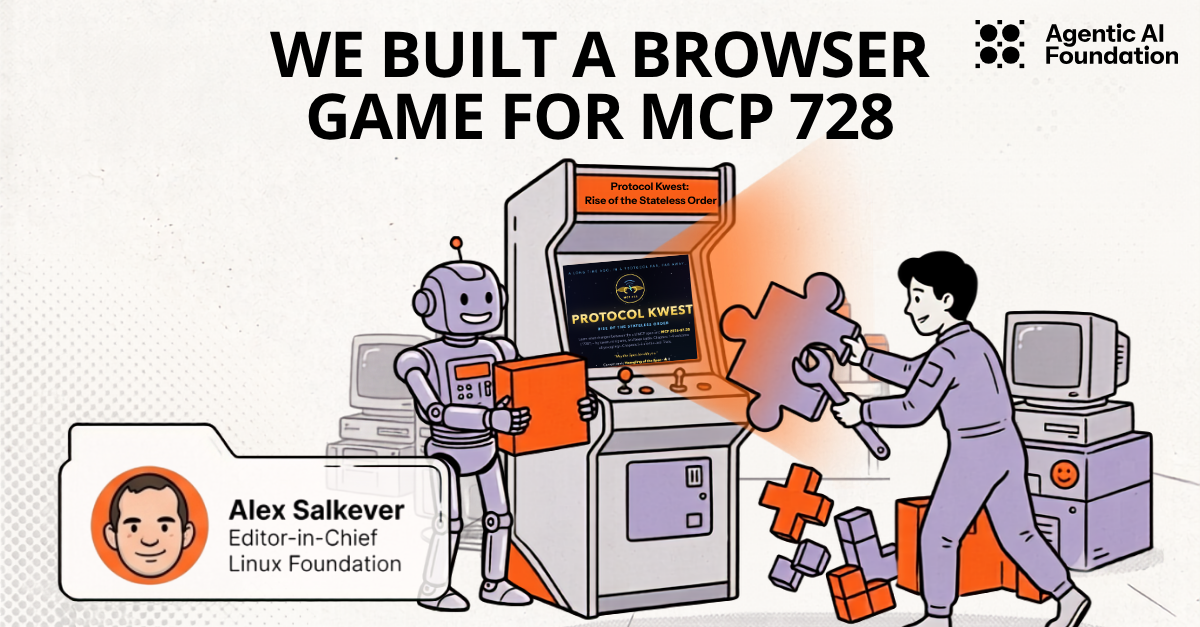

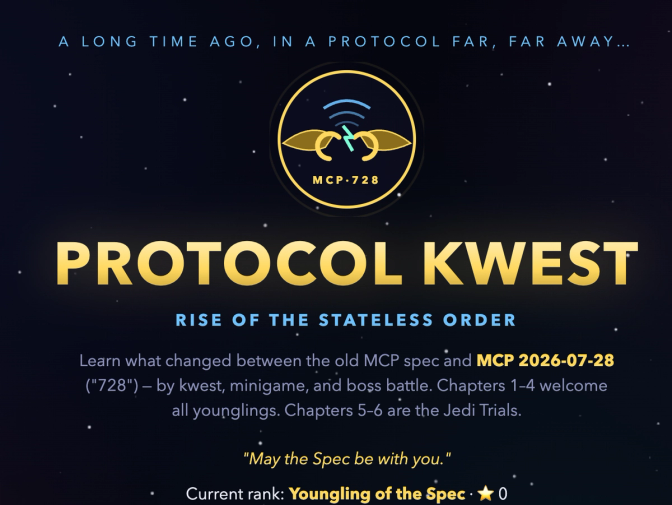
It’s Friday, time to unwind. And we figured it was a fine time to drop a small experiment. Introducing Protocol Kwest: Rise of the Stateless Order, a small game that runs in your web browser, and it teaches what changed in the MCP spec revision dated 2026-07-28. We built it as an exercise, because reading a changelog is a slow way to learn what moved in a protocol, and we wanted to see whether working through the changes as a game would stick better. At the AAIF, we are all about trying new experiments to engage and educate.
What the game covers
The game has six chapters, and each one takes one part of the 728 revision and ends in a minigame or a boss fight. The chapters cover:
- The version handshake, where a client and a server agree on which spec revision they both speak.
- The new request headers, e.g.
Mcp-Method, which let a gateway or load balancer route traffic by reading headers instead of parsing the message body. - Cache guidance. The old spec said nothing about how long a
tools/listresult stayed valid, so 728 addsttlMsfor the freshness window andcacheScopeto say whether a result is safe to share across users. - Tasks, which were experimental in the core spec and are now an opt-in extension that the server decides to use, once the client says it supports them.
- Authorization, and the pieces that moved out of the core spec entirely.
The first four chapters don't assume you've written MCP code before, and the later ones get more specific.
Everything runs in your browser
The game has no backend. Your progress and your score are saved in your browser's local storage, and nothing is sent to a server, so there is no global leaderboard. The leaderboard you see is your own machine's, and if you play on a different computer, you start over. Keeping the game as one static page made it quick to publish, and a shared leaderboard would mean running and maintaining a server, which is more than an exercise like this needs.
We vibe coded it, and it has warts
We wrote Protocol Kwest by prompting an AI coding tool and keeping whatever worked, which people call vibe coding. Some thought and engineering went into it, and we chose speed over polish, because we wanted to find out whether the idea worked before spending weeks on it. You should expect rough edges, and you'll probably find a bug we haven't.
Thanks to Mateo Torres at Arcade for playing it early and reporting real problems. He found a ship graphic that stretched and landed on planets you hadn't unlocked yet, and a scoring bug that let you farm points by replaying a chapter you'd already cleared. We fixed both, and we're sure others are still in there, so tell us what you hit.
Build something small yourself
When you write code with AI help, an experiment costs much less time than it used to, so a project doesn't have to turn into a product, and a prototype doesn't need a roadmap. A weekend project is enough. If Protocol Kwest gives you an idea for a game, a toy, or an odd way to explain something you're learning, build it, and we'd like to see it.
Happy kwesting and if you get the urge, build something fun to teach people about MCP or other AAIF technologies. We’d love to feature it.
Share
Author


Alex Salkever
View All PostsAlex Salkever is the Editor-in-Chief of the AAIF and the Linux Foundation. He has been working in open source storytelling for over a decade and formerly served as a CMO and VP at a number of technology companies. He started his career in journalism, ultimately working as the technology editor for Bloomberg BusinessWeek. He leads efforts to build the AAIF media engine to drive awareness and education.