
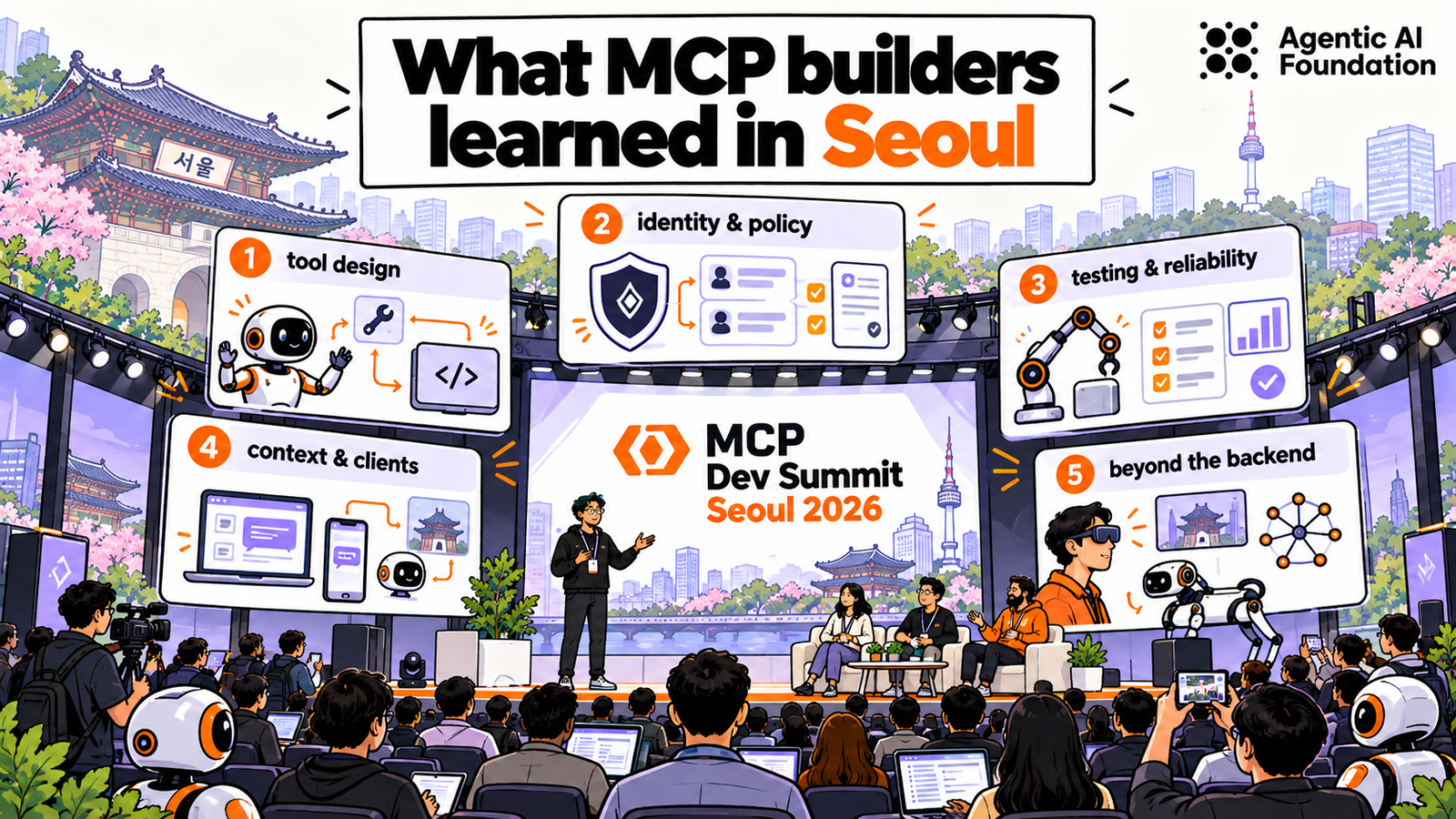

Across 43 recorded sessions at MCP Dev Summit Seoul 2026, speakers returned to practical questions around tool design, identity, context, testing, and production reliability. They also showed MCP being applied to robotics, mobile devices, video, computer vision, and ML-backed systems.
Note: Some sessions were presented in Korean; their quotes have been translated into English.
Building the agentic stack in the open
Speaker: Demetrios Brinkmann, Member Non-Technical Staff, AAIF (keynote)
From the talk: AAIF combines foundation governance, donated projects, and a user community so companies can contribute to a shared agentic stack.
Quote: "This is very special because no single company owns what we're building here."
Two years of MCP: state of the ecosystem
Speaker: Den Delimarsky, Member of Technical Staff, Anthropic (keynote)
From the talk: The latest MCP spec removes session handling and adds an extensions mechanism, while the SDK ecosystem has expanded well beyond the protocol's original scope.
Quote: "With this spec, we got rid of a whole bunch of cruft, things like sessions that developers no longer need to handle."
MCP and the new frontier for OSPOs
Speaker: Ana Jiménez Santamaría, Senior Project Manager, The Linux Foundation; AAIF Ambassador (keynote)
From the talk: OSPO practice can support MCP governance, with preliminary Linux Foundation Research data showing 35% of organizations with OSPOs already lead or co-lead AI governance work.
Quote: "And my last take is that, yes, open protocols have given us an interoperability layer, but perhaps now the next frontier to scale this adoption and have more organizations across different industries implementing this is operational trust."
From AI investment to business impact: an enterprise MCP playbook for the agentic era
Speaker: HyunSoo Kim, Solutions Architect, Workato (keynote, presented in Korean)
From the talk: Kim shows an enterprise MCP pattern that pairs live system data with validated business logic and centralized governance so agents can take controlled actions across existing systems.
Quote: "AI also needs to be able to call and execute predefined, validated business logic."
Beyond protocol compatibility: building an interoperable agent ecosystem
Speaker: Woo Hyung Choi, Principal Solutions Architect, Amazon Web Services (keynote, presented in Korean)
From the talk: Choi frames identity, authorization, observability, and stateless design as requirements around protocol compatibility when enterprises connect agents across systems.
Quote: "Observability and visibility are not optional. They are essential."
AAIF programs for the MCP community
Speaker: Demetrios Brinkmann, Member Non-Technical Staff, AAIF (keynote)
From the talk: AAIF is introducing an MCP certificate for the wider MCP community.
Quote: "This right here is our certificate for MCP."
AAIF Ambassador AMA: building the agentic future through community contribution
Speakers: Hoon Jo, Megazone; Junghwan Park, PyTorchKR; Daniel Oh, IBM; Ana Jiménez Santamaría, The Linux Foundation; Kevin Dubois, IBM
From the talk: The panel maps contribution routes through projects, working groups, Discord, and the ambassador program, with ways to participate beyond contributing code.
Quote: "I think it's really important that we get more projects onboarded in the foundation because ... it helps innovation and it helps collaboration between organizations."
Why enterprise MCP runs on Java
Speakers: Kevin Dubois, Developer Advocate, IBM; Daniel Oh, Senior Principal Developer Advocate, IBM
From the talk: Java and Quarkus bring established security, testing, observability, container, and Kubernetes practices into MCP services.
Quote: "It also means that all those things in the Java ecosystem, in terms of security, reliability, making it easy to run in production in a scalable way, need to be reinvented in Python."
Agent architecture and orchestration
Building MCP servers and agentic AI workflows in Java
Speakers: Kevin Dubois, Developer Advocate, IBM; Daniel Oh, Senior Principal Developer Advocate, IBM
From the talk: The workshop builds a Java MCP server and multi-agent workflow, then takes the same application through health checks, secrets, tracing, containerization, and Kubernetes deployment.
Quote: "And so basically, it's really kind of the same as any other kind of application with some extra capabilities."
How to use Sol-Terra-Luna in one goal
Speaker: Goobong Jeong, Founder, Team Attention (presented in Korean)
From the talk: A stronger model handles planning, while coding and repeatable work are delegated to other models and results from earlier runs feed into later decisions.
Quote: "I give Sol as much of the harder planning work before coding as possible, and have it distribute the coding and other tasks to the other models."
Skills and MCP: complementary, not competing
Speaker: Dale Seo, Software Engineer, Apollo GraphQL
From the talk: MCP suits live capabilities and changing data, while skills suit stable procedures and guidance, with both used together in the same agent workflow.
Quote: "One rule of thumb is to look at how often the information changes."
Why we made our AI agent platform a codebase before adding MCP
Speaker: Navtej Reddy, Software Engineer, Observe.ai
From the talk: Representing prompts, tools, and agent connections as files gave the team branches, diffs, reviews, versioning, and rollbacks before MCP integrations were added.
Quote: "The more and more our Agents got complicated, and the bigger they became to manage, we realized, hey, this is literally a code base in itself."
Self-improving MCP agents
Speaker: Kemal Elmizan, Software Engineer, GoTo Company
From the talk: Tool metadata can be updated from runtime evidence such as outcomes, failures, approvals, cost, and latency, allowing descriptions and routing to change with observed performance.
Quote: "Perhaps we should ask what metadata should emerge."
Evolving an LLMOps feedback system into an MCP-based agent architecture
Speakers: Ian Y. Choi, Containers Specialist, AWS; Taeyoung Kim, CEO, AIFactory (presented in Korean)
From the talk: A fixed feedback pipeline evolved into agents with shared state and MCP, with a coding agent added so users can extend the application through chat.
Quote: "The developer does the initial setup, but after that we built a system where the user can keep updating the application through chat."
When does an agentic workflow need MCP? Matching intelligence and interfaces to the outcome
Speaker: Junho Kong, AI Platform Architect, SK On (presented in Korean and English)
From the talk: Code, templates, APIs, workflow engines, and MCP suit different kinds of uncertainty, so the interface should follow the outcome the workflow needs.
Quote: "Start from the outcome, not from the model name or protocol."
Stateful AI agents: building consistent systems with MCP and distributed SQL
Speaker: Nasiullha Chaudhari, Developer Relations Manager, YugabyteDB
From the talk: A double-charge example shows why side-effecting agents need durable state, idempotency, transactions, and versioning when a timeout leaves the external outcome unknown.
Quote: "When you think it's a timeout it does not always mean it's a failure."
Who watches the watchmen? Safe AI-agent failover via MCP and CRDs
Speakers: Vitumbiko Mafeni, Senior Research Engineer, CNLAB | SSU IISTRC; Phuong Bac Ta, Research Assistant, Research Center for Distributed Cloud and Networking, SSU
From the talk: Mafeni and Ta show a failover flow in which the agent recommends an action, MCP constrains the request, a CRD records it, and Kubernetes controls what can execute, with human approval available.
Quote: "Define what the AI agent may request, and also let Kubernetes decide what can actually execute."
Building MCP servers and tool systems
A cloud service provider's MCP operations story: from MCP generator to MCP gateway
Speaker: Jihye Kim, Backend Engineer, Naver Cloud Platform (keynote, presented in Korean)
From the talk: Naver Cloud Platform moved from hand-built MCP servers to generated servers with quality checks, then to a gateway that searches a larger catalog and exposes only relevant tools.
Quote: "Building it well matters, but delivering it well matters too."
Building and taming an MCP server for multi-cloud vibe computing
Speaker: Seokho Son, Special Fellow, Principal Researcher, ETRI (presented mainly in Korean)
From the talk: Cost limits, tool curation, approval, model-agnostic testing, session recovery, and security controls all shaped the design of a multi-cloud MCP service.
Quote: "You should not build the server around one good model; you need to test it with other models too."
From 40 tools to 14: a practical framework for MCP tool curation
Speakers: Nimit Savant, Developer Advocate, DevRev; Gokul K S, Member of Technical Staff, DevRev
From the talk: Grouping overlapping object-specific APIs into intent-level contracts reduced the MCP surface from 40 tools to 14.
Quote: "So we just made it into a single contract where we designed tools based on intent and not by the type it or object it."
The 5 wrong reasons to build an MCP server (and what to do instead)
Speaker: Daniel Oh, Senior Principal Developer Advocate, IBM
From the talk: Five checks help determine whether MCP belongs in an architecture, starting with whether one agent calling one tool justifies the protocol overhead.
Quote: "So like just one agent, one tool, there is no good reason for MCP."
From legacy to agentic AI
Speaker: Seoyul Yoon, AAIF Community Seoul (presented in Korean)
From the talk: An existing specification can move through OpenAPI and MCP generation, with exposure and authentication controlled before deployment on Kubernetes.
Quote: "Nothing has to be redeveloped for the transition. The open-source pipeline takes over from the legacy specification through to the server."
From APIs to agentic toolkits: designing MCP flavors and a public MCP gateway at scale
Speaker: Faizan Akhtar, Software Engineer and React India Organizer, React India
From the talk: Task-specific tool flavors can reduce what an agent sees, while a gateway centralizes routing, security, observability, and evaluation.
Quote: "Platform doesn't just make more tools available, it makes the right tools discoverable, routable secure and measurable."
Security, identity and governance
Three gateways for the agentic era: an architectural framework for governing AI agent traffic
Speaker: Dakshitha Ratnayake, Developer Advocate, WSO2
From the talk: API, LLM, and MCP traffic can sit behind different gateway surfaces, with identity, policy, and observability applied across them as shared governance.
Quote: "So prepare each surface, govern them as one."
Hardening MCP integrations against tool poisoning
Speaker: Arshardh Ifthikar, Technical Lead, WSO2
From the talk: Approval at one point in time is not enough: in the Postmark MCP case, a later server version added code that copied emails to an attacker's address.
Quote: "There can be cases like this where tool descriptions change, the code changes, and suddenly these different servers become vulnerable."
Secure MCP servers in production: a practical guide for developers
Speaker: Valeri Milke, Chief Executive Officer, VamiSec GmbH
From the talk: Production MCP servers need conventional application security alongside agent-specific threat modeling, allow-listing, approval, centralized logging, and repeated testing.
Quote: "It's also very important to know what our agents have done."
Authorization in MCP systems: getting it right from the start
Speaker: Aram Andreasyan, Head of Solutions Engineering, Cerbos
From the talk: Externalized policy can filter which tools an agent discovers and evaluate each call against identity, tool, arguments, limits, and assigned work.
Quote: "So the key here is maybe when it comes to having the right agent role types, is figuring out exactly which tools are they able to see within the list."
Who authorized that agent? Identity and policy enforcement for MCP tool calls
Speaker: Jorge Ruiz Arto, Director of Product Marketing, Gravitee
From the talk: Identity can be traced from the user through an MCP proxy to the backing API, with actor, action, and resource policy enforced at tool level.
Quote: "So this allows us to have very granular control on what each actor can do at a tool level."
Beyond APIs: making MCP services faster and secure with WebAssembly
Speaker: Brandon Kang, Principal Technical Solutions Architect, Akamai Technologies (presented in Korean)
From the talk: A WebAssembly and WASI sandbox can start MCP tools without host privileges and grant only the filesystem, network, or environment access each tool needs.
Quote: "With WebAssembly, you start from a blank slate and give only the permissions you really need, which is the safer approach."
Reliability, testing and production operations
Stop wrapping APIs: building structured execution boundaries with MCP for incident triage
Speaker: Sunyoung Park, Research Engineer, KC-ML2
From the talk: A thin incident-triage wrapper recommended moving traffic to an offline server, while a structured execution boundary gathered the required evidence before returning a checked action.
Quote: "The operational judgment should live in a reusable execution boundary."
Building and testing MCP servers with the Inspector, conformance suites, and property-based testing
Speaker: Navin Pai, Director of Engineering, StackGen
From the talk: Inspector checks, conformance tests, property-based fuzzing, linting, and evals can be combined into a CI suite that runs on every MCP server commit.
Quote: "And broadly, how you bring this entire system together where ideally, every time you're building an MCP Server and with every commit, it runs this entire suite of tests."
From CRDs to conversations: simplifying chaos engineering with MCP
Speaker: Pritesh Kiri, Software Developer Relations Engineer and Community Manager, Harness
From the talk: MCP can lower the operational barrier to chaos engineering, which often sits with platform engineers and SREs because it requires knowledge across several infrastructure and DevOps areas.
Quote: "Right now only platform engineers or SRE people can use chaos engineering because it needs a lot of knowledge from different sources."
When MCP tools fail: reliable ML inference for MCP agents
Speaker: Sho Tanaka, Lead Developer Advocate, Snowflake
From the talk: Four checks around ML-backed MCP calls cover request, execution, result, and identity, with model and version information carried through traceable metadata.
Quote: "Can we identify exactly what produced the result? Which server? Which model? Which version?"
Context, clients and developer experience
The context budget crisis: why MCP needs server-side response controls
Speakers: Nimit Savant, Developer Advocate, DevRev; Gokul K S, Member of Technical Staff, DevRev
From the talk: Tool search, progressive schema disclosure, and server-side response filtering can keep unused schemas and raw results out of model context.
Quote: "So yeah, spend context on reasoning, not actually plumbing data filtering."
Closing the context gap: making your APIs agent-ready
Speakers: Aanchal Mishra, Developer Advocate, Postman; Ali Mustufa Shaikh, Senior Developer Advocate, Pieces AI
From the talk: API quality checks, generated MCP servers, isolated harness testing, and a persistent source of truth can help agents act against a checked API contract.
Quote: "Instead of verifying all individual use cases, we just rely on a source of truth."
Two audiences, one Markdown file: writing MCP docs an agent can actually use
Speakers: Tanisha Sharma, DevRel Engineer, Bolna; Jyoti Bisht, Senior Developer Relations Engineer, Independent
From the talk: Ambiguous documentation can fail when agents retrieve it in chunks, while explicit rules and precise wording make those chunks easier to use without human trial and error.
Quote: "So we have to make sure that the documentation that is written is extremely precise and to the point."
Your MCP server behaves differently in every client: a cross-client field guide for server authors
Speakers: Tanisha Sharma, DevRel Engineer, Bolna; Animesh Pathak, Developer Relations Engineer, Harness
From the talk: The same MCP server can behave differently across clients because of description limits, notifications, OAuth, gateways, and session handling, so cross-client traces should be part of the test plan.
Quote: "It failed without any error, without any warnings."
Managing token usage in MCP servers using Code Mode
Speaker: Bhumika Satpathy, Software Engineer, Google
From the talk: Code Mode can expose a smaller tool surface, let the model compose executable steps, and keep bulk data processing inside a sandbox instead of the model context.
Quote: "In my experience, Code Mode has led to significant token cost reduction."
MCP beyond the backend
Commanding SO101 with agents
Speaker: Anshuman Singh, Head of Operations, Devfolio
From the talk: An agent can control an SO101 arm through MCP, with camera input adding environment awareness to actions that would otherwise be fixed commands.
Quote: "If you integrate these MCP server solutions or agents, and have a camera integrated in among them, I think there are tons of possibilities and solutions."
MCP on mobile: how far have we come?
Speaker: Sasha Denisov, CTO and Co-founder, Brainform.ai
From the talk: Phones work well as MCP clients, while hosting a server on-device brings constraints around sandboxing, foreground and background rules, networking, and secure reachability.
Quote: "In case of iOS, it's foreground only."
From API to agent: building a video intelligence MCP server and plugin ecosystem
Speaker: Kyle Cabigon, Product, TwelveLabs
From the talk: A video MCP needs to handle ingestion, long-running jobs, corpus-scale queries, and visual rendering so users can get playable evidence back instead of text alone.
Quote: "Video by itself inherently is a very visual modality."
When AI agents need eyes: what MCP can and cannot standardize for computer vision
Speaker: Seowoo Han, Computer Vision Software Engineer, B GARAGE (presented in Korean)
From the talk: Agents can review and correct simpler vehicle-labeling tasks, but more complex production decisions still need human judgment at specific points in the workflow.
Quote: "For now, I think agents still need a human in the loop at exactly the right point."
Operating an AI infrastructure through MCP Apps on agents
Speaker: HyounKyoung Moon, Agentic AI Lead, Lablup (presented in Korean)
From the talk: MCP Apps can move infrastructure inspection into the agent conversation, letting operators identify idle and old resources, inspect activity, and decide what should be removed without working through separate dashboards.
Quote: "Without going to the dashboard, we can ask the agent: What idle resources are there? What's old? What's in the activity log? What should I delete? Tell me."
Share
Author