Technical Committee
Model Context Protocol
MCP Graduates to Enterprise Infrastructure: Stateless Architecture, Formal Governance, and Security Hardening
Caitie McCaffrey2026-07-28

Build with open standards, learn from real practitioners, and shape where agentic AI is going—alongside the people doing the work.

DAILY AGENTIC AI LINKEDIN NEWSLETTER
Moonshot AI and kvcache-ai open-sourced AgentENV, a high-throughput distributed system engineered for agentic reinforcement learning. Developed to support RL training for Kimi models, the platform features sub-second environment snapshotting, state resumption, and tree-forking capabilities across thousands of parallel agent interaction loops. Standardizing distributed environment scaling simplifies reinforcement learning infrastructure for developers training complex reasoning agents.
Microsoft launched Project Perception, a system in which red-team agents find attack paths, blue-team agents investigate risk, and green-team agents apply fixes. Its MDASH harness routes roughly 90% of tasks to the specialized MAI-Cyber-1-Flash model and reserves GPT-5.4 for the hardest 10%, scoring 95.95% on CyberGym at half the cost of Microsoft’s previous configuration. The frontier in cyber defense is shifting from agents that find vulnerabilities to coordinated systems that can find, prioritize, and repair them continuously.
NVIDIA expanded its Agent Toolkit with agent-ready PhysicsNeMo and CUDA-X libraries, while Siemens, Cadence, and Synopsys are integrating the stack into semiconductor and industrial-design workflows. Agents can now invoke sparse solvers, quantum-chemistry calculations, deterministic EDA engines, and the open Nemotron 3 Ultra model; Siemens says its implementation cut library-characterization time by more than 10× while reducing token costs by 5–10×. Following on the heels of BioNeMo release, this one means agents’ work is continuously checked against the same simulation and verification tools engineers trust, “industrializing” agentic AI.
News and Views from the AAIF
Moonshot AI and kvcache-ai open-sourced AgentENV, a high-throughput distributed system engineered for agentic reinforcement learning. Developed to support RL training for Kimi models, the platform features sub-second environment snapshotting, state resumption, and tree-forking capabilities across thousands of parallel agent interaction loops. Standardizing distributed environment scaling simplifies reinforcement learning infrastructure for developers training complex reasoning agents.
Microsoft launched Project Perception, a system in which red-team agents find attack paths, blue-team agents investigate risk, and green-team agents apply fixes. Its MDASH harness routes roughly 90% of tasks to the specialized MAI-Cyber-1-Flash model and reserves GPT-5.4 for the hardest 10%, scoring 95.95% on CyberGym at half the cost of Microsoft’s previous configuration. The frontier in cyber defense is shifting from agents that find vulnerabilities to coordinated systems that can find, prioritize, and repair them continuously.
NVIDIA expanded its Agent Toolkit with agent-ready PhysicsNeMo and CUDA-X libraries, while Siemens, Cadence, and Synopsys are integrating the stack into semiconductor and industrial-design workflows. Agents can now invoke sparse solvers, quantum-chemistry calculations, deterministic EDA engines, and the open Nemotron 3 Ultra model; Siemens says its implementation cut library-characterization time by more than 10× while reducing token costs by 5–10×. Following on the heels of BioNeMo release, this one means agents’ work is continuously checked against the same simulation and verification tools engineers trust, “industrializing” agentic AI.

Weekly signal on standards, governance, and the people building the future. No fluff. Just what matters.

Insights and perspectives from the builders, contributors, and innovators advancing the field.

AAIF Working Groups bring members together to collaborate on focused initiatives, share expertise, and drive practical outcomes across the AI ecosystem.


Bringing operational rigor to agents — defining what reliability, accuracy, and consistency mean for autonomous systems, including failure management, SLA definition, and recovery protocols.

Bringing operational rigor to agents — defining what reliability, accuracy, and consistency mean for autonomous systems, including failure management, SLA definition, and recovery protocols.

Enabling agents to participate in commerce — covering discovery, negotiation, payment authorization, and the protocols needed for trustworthy autonomous transactions.


Creating shared frameworks to align agentic innovation with legal, ethical, and regulatory expectations, including risk classification and regulatory mapping (e.g. the EU AI Act).

Defining portable identity and dynamic trust for autonomous agents — delegation protocols, cross-domain identity, and how permissions flow across agent-to-agent interactions.


Making agent behavior observable, explainable, and traceable across platforms — covering execution tracing, cross-system correlation, audit & forensics, and standardized metrics.

Establishing the industry benchmark for secure agentic operations, with a focus on security-by-design, standardized best practices, and adversarial testing methodologies.

Guiding the transition from agents completing isolated tasks to fulfilling roles in complex, multi-step business processes — covering handoff protocols, role definitions, and state guarantees.


Learn from experts, connect with peers, and discover new opportunities to contribute.

Attend events to share insights, expand your network, and help shape what comes next.
Upcoming Community Events
August 2026
Upcoming Agentic AI Events
MCP Dev Summit Seoul
AGNTCon + MCPCon China
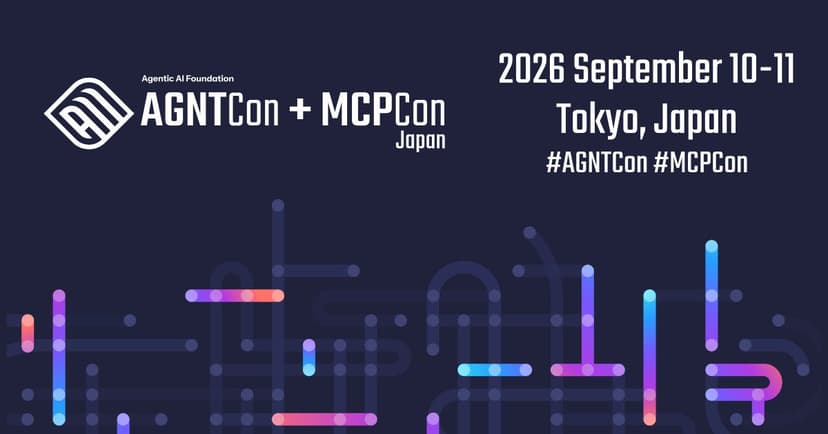
AGNTCon + MCPCon Japan
Voice Agents Forum
AGNTCon + MCPCon Europe
MCP Dev Summit Toronto
AGNTCon + MCPCon North America
MCP Dev Summit Nairobi
August 2026
Upcoming Community Events
Upcoming Agentic AI Events
MCP Dev Summit Seoul
AGNTCon + MCPCon China
AGNTCon + MCPCon Japan
Voice Agents Forum
AGNTCon + MCPCon Europe
MCP Dev Summit Toronto
AGNTCon + MCPCon North America
MCP Dev Summit Nairobi
Discover what the community is building—and how you can get involved. Contribute to AAIF projects, collaborate with others, and help shape the future of AI.
Contribute to the future of open, community-driven AI by submitting your project proposal through the official GitHub process.